




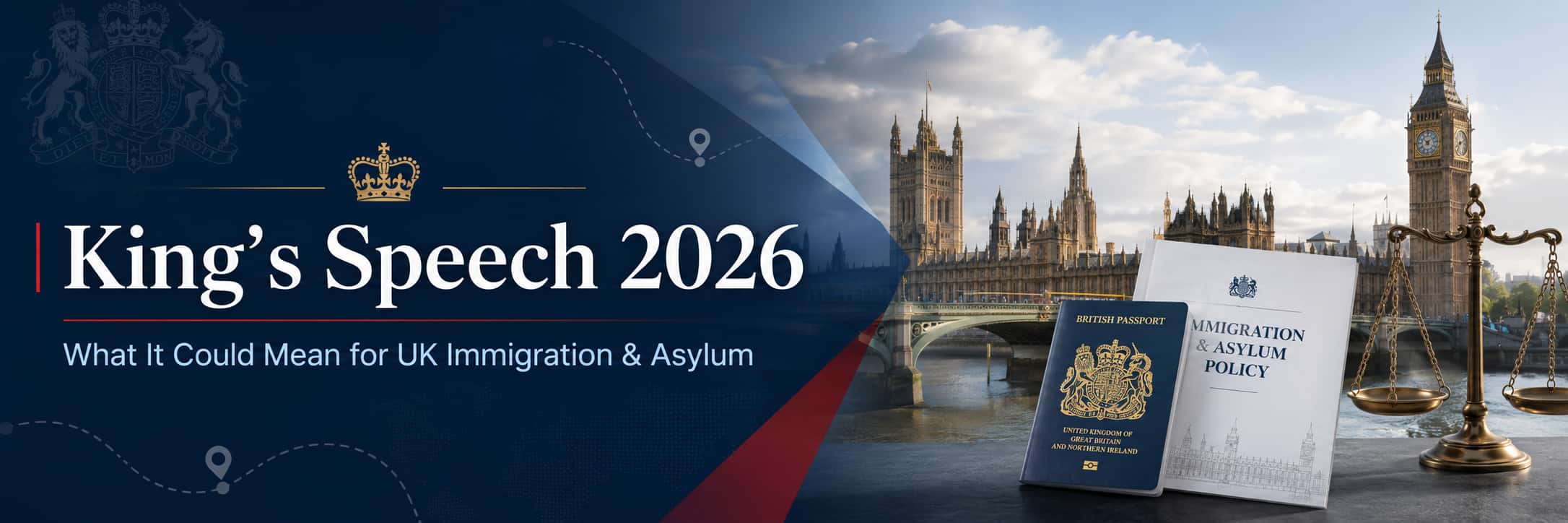
The King’s Speech on 13 May 2026 included important immigration and asylum announcements. While the wording in the speech was brief, the message was clear: the government intends to bring forward new legislation to tighten parts of the UK immigration and asylum system.
This is not just a political update. It could affect asylum seekers, refugees, families, employers, communities, and legal advisers across the UK.
1. A new Immigration and Asylum Bill is expected
The government announced plans for a new Immigration and Asylum Bill.
The aim is to increase public confidence in the immigration and asylum system. In practice, this is likely to mean stricter rules, faster removals, and more controls around asylum claims and appeals.
However, it is important to remember that the King’s Speech itself does not change the law. It only sets out what the government plans to introduce during the parliamentary session.
2. Refugee protection may become more temporary
One of the biggest expected changes is a move towards a new “core protection” model.
This could mean that refugee protection becomes more temporary and subject to regular review. Instead of refugee status giving a clear route to long-term settlement, people may need to prove again that they still need protection.
This could create uncertainty for many refugees trying to rebuild their lives in the UK.
3. The route to settlement could become longer
The government has previously indicated that refugees may face a much longer route before becoming settled in the UK.
This would be a major shift from the current system, where many refugees can apply for settlement after five years.
A longer route to settlement could affect housing, employment, education, family planning, and mental health. It may also make integration harder because people cannot fully settle if their future remains uncertain.
4. Faster removals after appeals are finished
The Bill is expected to focus on speeding up removals once a person has exhausted their appeal rights.
Supporters may see this as a way to make the system more effective. However, the key legal concern will be fairness.
Immigration and asylum decisions can be complex. Mistakes can happen. A faster system must still make sure people have a fair opportunity to challenge incorrect decisions before removal.
5. Article 8 family and private life claims may be tightened
The government is also expected to make changes around Article 8, which protects the right to private and family life.
This could affect people who rely on long residence, family relationships, children’s best interests, or strong private life ties in the UK.
Article 8 is often discussed politically as a loophole. But in real life, it often involves very human situations: parents, children, partners, carers, and people who have built their lives here over many years.
6. Age assessment rules may become stricter
Another expected area of reform is age assessment.
The government wants stronger rules to identify adults who wrongly claim to be children. At the same time, the system must protect genuine children who arrive without documents or clear proof of age.
This is a sensitive area. A wrong decision can have serious consequences, especially for vulnerable young people.
7. Modern slavery protections may also change
The Bill is expected to include reforms to modern slavery laws.
The government says it wants to prevent misuse of the system while continuing to protect genuine victims.
This balance will be difficult. Many victims of trafficking and exploitation do not disclose their experiences immediately. Trauma, fear, language barriers, and control by exploiters can all delay disclosure.
A system based only on suspicion may risk failing the very people it is meant to protect.
8. This is not law yet
It is very important not to confuse an announcement with a legal change.
The King’s Speech sets out the government’s plans. The law will only change after legislation is introduced, debated, passed by Parliament, and brought into force.
The final impact will depend on the exact wording of the Bill, any amendments, commencement dates, Home Office guidance, and possible court challenges.
9. What should people do now?
People affected by the immigration or asylum system should stay informed but should not panic.
Applicants, families, employers, sponsors, and advisers should watch closely for the actual Bill and any changes to the Immigration Rules.
The direction of travel appears to be stricter, more conditional, and more focused on control. But the details will matter.
Final thought
Immigration policy is often debated through statistics and political slogans.
But behind every case is a person, a family, and a future.
Any reform must balance control with fairness, efficiency with justice, and public confidence with human dignity.