





UK immigration is evolving again in 2025. Here’s a clear snapshot of what’s changed, what’s coming, and what’s currently under review.
- Partner / Family Visa – Minimum Income Requirement
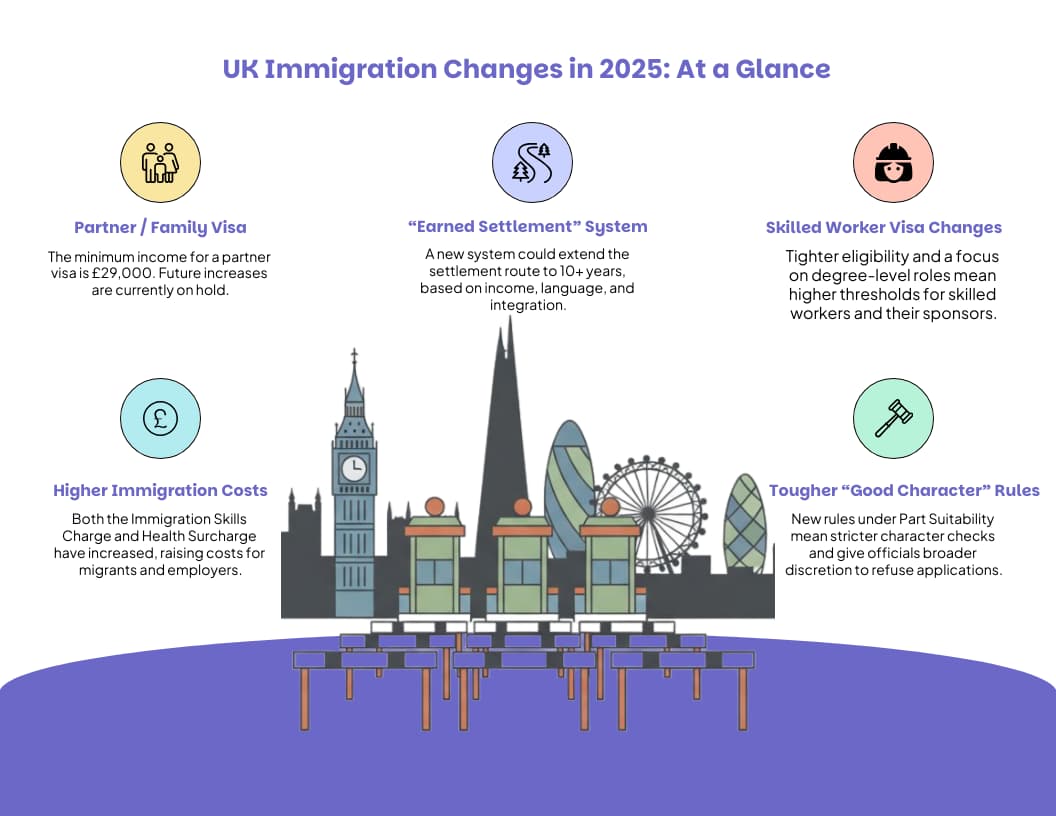
The minimum income requirement for sponsoring a partner or spouse to the UK currently sits at £29,000 a year.
Plans by the previous government to push this up further — to £34,500 and eventually £38,700 — have been put on hold since Labour came into office.
An independent review by the Migration Advisory Committee has since suggested that the current threshold may be too high, especially when compared with other high-income countries. Despite that, no changes have been made yet.
What this means:
There’s plenty of debate, and change is still possible — but for now, £29,000 remains the rule.
2. “Earned Settlement” – A Major Shift on the Horizon
The government has launched a wide-ranging consultation on a new “earned settlement” system — and this could fundamentally change how migrants qualify for permanent residence.
Under the proposals:
- The standard route to settlement could stretch from 5 years to 10 years or more
- Eligibility may depend on income levels, tax contributions, English language ability, and integration
- Settlement would become something you actively earn over time, rather than simply complete
The consultation runs until 12 February 2026.
Why this matters:
This could be the biggest shake-up to settlement rules in decades.
3. Skilled Worker & Work Visa Changes
Throughout 2025, the government has made a series of adjustments to Skilled Worker and related work routes.
Key themes include:
- Tighter eligibility criteria in some categories
- A stronger emphasis on degree-level roles
- Ongoing regulatory changes for employers who sponsor migrant workers
There’s no single headline change — but taken together, the direction is clearly towards greater control and higher thresholds.
4. Higher Costs for Employers and Migrants
Immigration is also becoming more expensive:
- The Immigration Skills Charge has risen to £1,320 per sponsored worker, per year
- The Immigration Health Surcharge has increased to £1,035 per year, with lower rates for dependants
The impact:
Employers face higher sponsorship costs, and migrants are paying significantly more just to access the system.
5. Tougher “Good Character” Rules
From November 2025, the long-standing “Part 9” refusal rules are being replaced by a new framework called “Part Suitability”.
In practice, this means:
- Stricter checks on character and conduct
- Broader discretion for decision-makers
- Past behaviour — even outside immigration history — may carry more weight
6. The Bigger Picture
Taken together, these developments point to a clear direction of travel.
Across both Conservative and Labour governments, UK immigration policy in 2025 is focused on:
- Reducing net migration
- Raising financial and contribution thresholds
- Prioritising economic contribution
- Making settlement and family life in the UK harder to access, slower to achieve, and more conditional
Whether this strikes the right balance — or goes too far — is the question shaping the immigration debate right now.
Final thought
Immigration rules don’t just shape who comes to the UK; they shape who can stay, who can settle, and who can build a future here.
As thresholds rise and routes grow longer, the risk is that policy becomes more about endurance than contribution.
Getting that balance right will define the next chapter of UK immigration.