






For individuals on a Skilled Worker visa, long-term security in the United Kingdom depends on one critical question:
When does the five-year settlement clock actually begin?
On the surface, it seems straightforward. In practice, it is anything but.
Appendix Continuous Residence is one of the most frequently misunderstood parts of the Immigration Rules. A small miscalculation — sometimes just a few weeks — can delay Indefinite Leave to Remain (ILR) by months or even years.
While the requirement is clear — five years of continuous residence — the technical rules governing when that period starts, what time counts, and how it is calculated are where many applicants encounter difficulty.
Understanding this properly is not optional. It is essential.
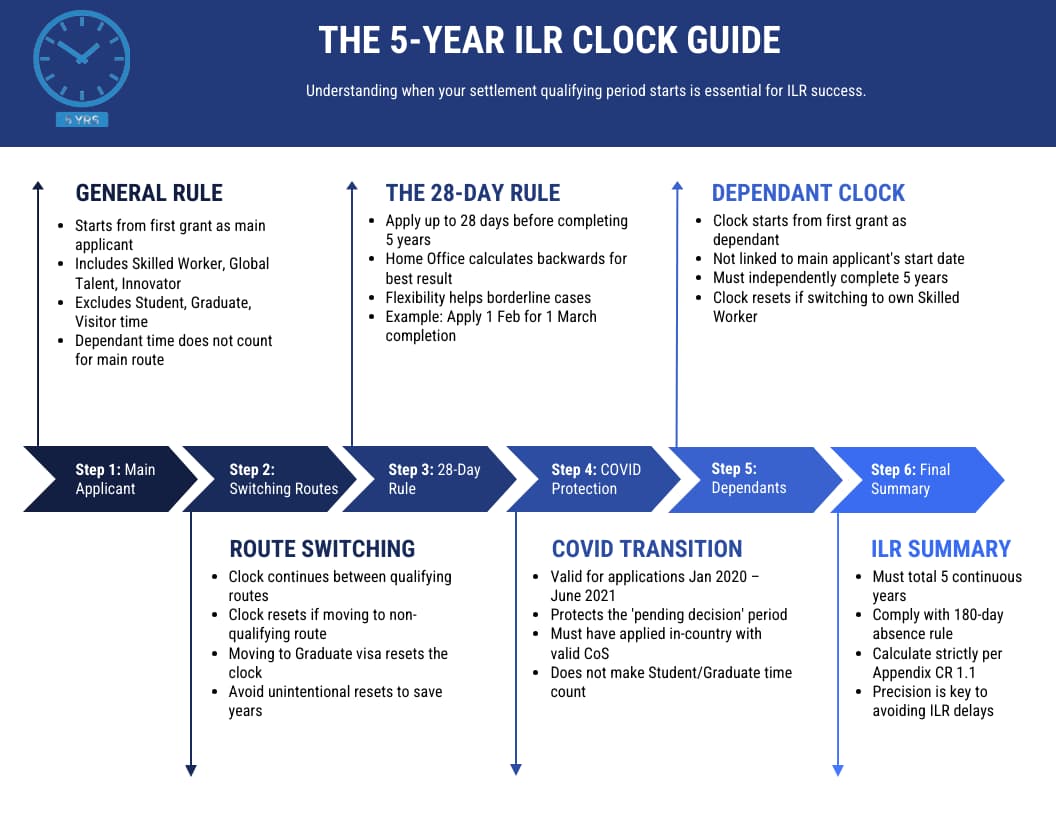
1️⃣ The General Rule: The Clock Starts When You Become a Main Applicant
Your 5-year qualifying period starts from:
The date you were first granted permission as a main applicant on a qualifying route.
That means:
✅ Skilled Worker
✅ Global Talent
✅ Innovator Founder
✅ Scale-up
✅ Tier 1 (except Graduate Entrepreneur)
✅ T2 Minister of Religion
✅ Representative of an Overseas Business
It does NOT include:
❌ Time as a dependant
❌ Student visa
❌ Graduate visa
❌ Visitor visa
If you were previously a dependant and later switched to Skilled Worker in your own right?
👉 Your 5-year clock starts from the Skilled Worker grant date.
2️⃣ Switching Routes – Does the Clock Reset?
Not always.
If you move between qualifying main applicant routes (e.g., Global Talent → Skilled Worker), your clock continues.
But if you move to a non-qualifying route (e.g., Graduate) and then back?
👉 The clock resets.
This is where many applicants lose years unintentionally.
3️⃣ The 28-Day Rule (CR 1.1) – A Strategic Advantage
Under Appendix Continuous Residence, you can:
Apply up to 28 days before completing your full 5 years.
The Home Office calculates your qualifying period backwards from whichever is most beneficial:
- Date of application
- Date of decision
- Or up to 28 days after the date of application
This flexibility can rescue borderline cases.
Example:
If your 5 years complete on 1 March 2026,
you can apply on 1 February 2026.
That 28-day window matters.
4️⃣ The COVID Transitional Rule (SW 21.2(i)) – Narrow But Powerful
Between 24 January 2020 and 30 June 2021, there was a special protection.
If you:
✔ Applied in-country, i.e. permission to stay
✔ Had a valid Certificate of Sponsorship
✔ Applied within that window
✔ And your Skilled Worker application was granted
Then the period while waiting for the decision can count toward your 5 years.
Important:
This does NOT make Student or Graduate time count generally.
It only protects the “pending decision” period.
Many people overlook this — and lose months of qualifying time.
5️⃣ DEPENDANTS – WHEN DOES THEIR CLOCK START?
Dependants have their own 5-year clock.
It starts from:
The date they were first granted permission as a dependent.
Not from when the main applicant started (unless granted simultaneously).
If a dependant becomes a Skilled Worker in their own right?
👉 Their clock resets.
FINAL SUMMARY
For Skilled Workers
Continuous residence starts from:
First grant of permission as a main applicant on a qualifying route.
The qualifying period:
- Must total 5 continuous years
- Must not include dependant time
- Must comply with the 180-day absence rule
- May benefit from the COVID transitional protection (Jan 2020 – June 2021 only)
- Must be calculated strictly in accordance with CR 1.1
For Dependants
Continuous residence starts from:
First grant of permission as a dependant.
They must independently complete 5 years.
Final Thought
Five years is not just a date — it’s a calculation.
Settlement depends on getting the timeline right: the correct start date, qualifying route, absence limits, and technical rules under Appendix Continuous Residence.
A small mistake can delay ILR by months — or even reset the clock entirely.
Before applying, make sure the five years you are relying on are the right five years.
Because in immigration law, precision is everything.