






The UK’s immigration system may be on the brink of its most significant structural shift in decades.
With the closure of the government’s Earned Settlement consultation, and reports of an unprecedented volume of responses, the message is clear: this is no minor technical reform. It is a fundamental re-definition of what permanent residence in the United Kingdom means.
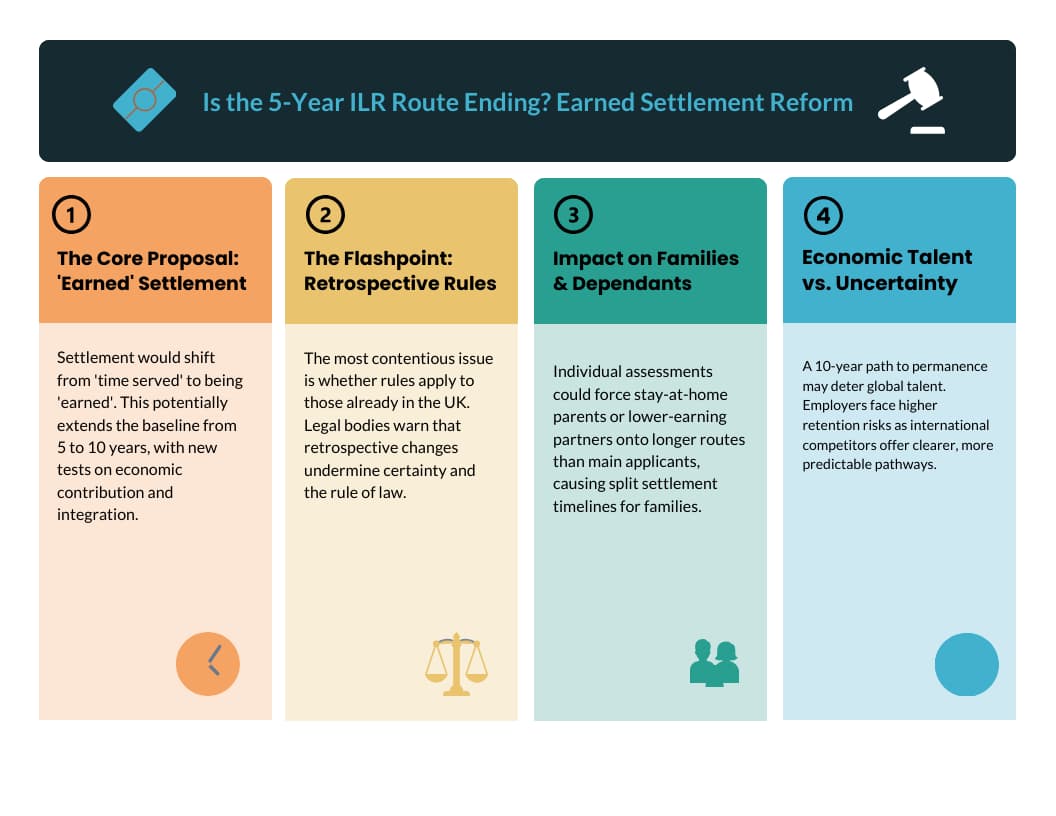
1️⃣ The Core Proposal: From “Time Served” to “Earned”
For decades, many work routes — including Skilled Worker — have operated on a relatively clear principle:
Complete five years of lawful, continuous residence → qualify for Indefinite Leave to Remain (ILR), subject to meeting requirements.
The government’s new proposal would fundamentally change that model.
Instead of a standard five-year pathway, settlement would become something that must be “earned” — potentially extending the baseline to 10 years, with additional contribution-based tests focusing on:
- Economic contribution
- Character
- Salary thresholds
- Integration and community engagement
This marks a conceptual shift away from predictability and towards performance-based permanence.
2️⃣ A Consultation with Huge Response
According to reporting by the Electronic Immigration Network, the consultation attracted an enormous response—reportedly over 130,000 submissions as of 4th February 2026.
Home Secretary Shabana Mahmood described it as a serious and meaningful exercise. That volume alone indicates the scale of concern across:
- Migrant communities
- Employers
- Legal professionals
- Civil society groups
When immigration consultations generate this level of engagement, it signals structural consequences — not cosmetic reform.
3️⃣ The Central Flashpoint: Retrospective Application
The single most contentious issue is not the new 10-year model itself.
It is this question:
Will the new rules apply to people already in the UK who arrived under the expectation of a five-year settlement route?
Legal bodies have been unequivocal.
The Law Society of England and Wales has warned that retrospective changes could undermine:
- Legal certainty
- Legitimate expectation
- Rule of law principles
Migrants who relocated families, purchased property, and built long-term plans on the basis of existing rules may find the goalposts moved mid-journey.
That is not merely policy change — it is a re-writing of settled expectations.
4️⃣ Families: The Overlooked Impact
Another major concern raised across commentary is how the scheme will treat dependants.
If contribution metrics are assessed individually:
- Stay-at-home parents
- Carers
- Students
- Lower-earning partners
could face longer routes than the main applicant.
That could create split settlement timelines within the same family.
The consequences?
- Visa insecurity for one partner
- Delayed citizenship for children
- Increased cost burdens
- Prolonged temporary status for families fully integrated into UK society
5️⃣ Economic Implications: Talent vs Uncertainty
From an employer perspective, this reform raises serious strategic questions:
- Will global talent commit to the UK with a 10-year path to permanence?
- Will businesses face higher retention risk?
- Will international competitors benefit from offering clearer settlement pathways?
The UK’s competitiveness has historically been supported by predictable settlement routes. If predictability diminishes, recruitment dynamics may shift.
6️⃣ The Bigger Philosophical Shift
At its heart, this is about redefining what settlement means.
Under the current system:
Settlement is a milestone after lawful residence and contribution.
Under the proposed system:
Settlement becomes a reward for sustained economic performance.
That is a profound policy recalibration.
It reframes permanent residence from a rights-based progression to a merit-conditioned privilege.
7️⃣ What Happens Next?
The consultation on the Earned Settlement proposals closed on 12 February 2026.
The government is now analysing responses — and the next phase is critical.
A Statement of Changes to the Immigration Rules is expected to be laid before Parliament in March 2026.
That is when the final framework will be published.
Implementation is anticipated to begin from April 2026, with reforms introduced on a phased basis throughout the remainder of 2026.
But several pivotal questions remain:
- Will there be transitional protection for migrants already on a 5-year route?
- How strict will the contribution criteria be — salary thresholds, National Insurance history, integration tests?
- Will settlement remain predictable — or become discretionary?
- How will dependants and families be treated under the new model?
For employers, Skilled Workers, and families planning long-term futures in the UK, the coming months are decisive.
By the end of 2026, the structure of UK permanent residence may look very different.
Final Thought
Immigration reform goes beyond just numbers; it centres around trust. It is about the assurance that the rules governing someone's significant life changes will not alter unexpectedly during their journey.
The debate over earned settlement is not merely an administrative issue; it represents a crucial moment in how the UK defines belonging, permanence, and fairness within its immigration system. The choices made today will influence not only migration statistics but also the everyday experiences of millions of people.