





On Monday 2 February 2026, MPs debated Indefinite Leave to Remain (ILR) in Westminster Hall following two e-petitions signed by over 330,000 people.
This was not a vote on new law.
There was a debate on whether the Government's proposed shift from the 5-year settlement model to a longer "earned settlement" approach is fair, workable, and justified.
For migrants, employers, sponsors, and advisors, this debate is important because it reveals the Government's thought processes and highlights unresolved issues.
What was the debate really about?
1️⃣ Extending the ILR qualifying period
The Government has signalled a move from 5 years to 10 years for most migrants.
2️⃣ Whether changes could apply retrospectively
In other words: would people already in the UK, mid-journey to settlement, be caught by new rules?
3️⃣ Linking settlement to “contribution”
Through an earned settlement model, potentially involving:
- public service work
- volunteering
- higher English language requirements
- stricter compliance expectations
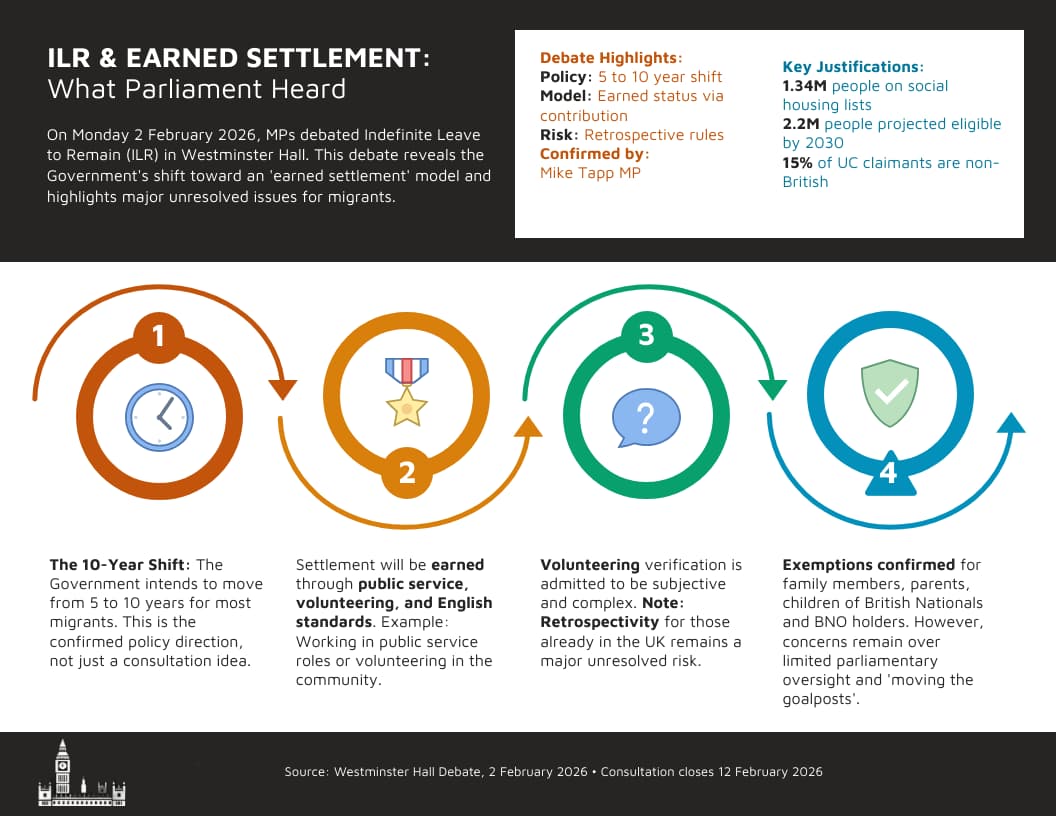
The Government Response: What Mike Tapp MP Confirmed
Speaking for the Government, Mike Tapp MP set out the clearest explanation so far of how ministers justify these reforms.
Here’s what he explicitly said — and what it means.
1. The Government intends to move from 5 to 10 years
The Minister confirmed that the Government has already set out plans to increase the standard ILR qualifying period from five to ten years.
This is not a consultation “idea”. It is the policy direction.
2. “Earned settlement” will replace automatic settlement
Under the proposed model, settlement will no longer be primarily about time served.
Instead, migrants may need to earn reductions to a longer settlement clock through:
- working in public service roles
- volunteering
- meeting higher English language standards
- demonstrating compliance and “integration”
At the same time, the Government proposes penalties — longer routes or restrictions — for those who:
- claim public funds
- breach immigration rules
The Minister was clear: this is intended to change behaviour, not simply grant status.
3. Volunteering is a pillar — but the Government admits it’s unclear
When challenged on how volunteering would be verified, regulated, or protected from abuse, the Minister openly acknowledged:
- the system would be subjective
- it is complex
- details are not yet decided
- this is why it is still under consultation
This was one of the most revealing moments of the debate:
the Government accepts that a core pillar of “earned settlement” is not yet operationally defined.
4. Housing and welfare pressure is the Government’s main justification
The Minister repeatedly returned to numbers:
- 1.34 million people currently on social housing waiting lists
- a projected 2.2 million people becoming eligible for settlement between 2026–2030
- around 15% of Universal Credit claimants being non-British nationals
He argued that, even if not all migrants access benefits or housing, some will, and the system is already at capacity.
This framing matters, because it shows that settlement reform is being driven as much by domestic infrastructure pressure as by immigration policy itself.
5. Two clear exemptions were confirmed
The Minister said two groups will retain five-year routes, outside the consultation:
✔️ Partners, parents and children of British citizens
✔️British National (Overseas) visa holders from Hong Kong
This was presented as a matter of fairness and historic commitment.
6. Retrospectivity: still unresolved
Crucially, the Minister did not rule out applying new rules to people already in the UK.
Instead, he repeatedly said:
- transitional arrangements are under consultation
- he cannot “prejudge” the outcome
- an impact assessment will follow once consultation ends
This lack of certainty was one of the strongest points of concern raised by MPs across the Chamber.
7. Parliament may not get a full vote
When asked whether ILR changes would be voted on by the whole House, the Minister said they were “likely to be”, but confirmed that no final decision has been taken.
That raised serious concerns among MPs about:
- rule changes via secondary legislation
- limited parliamentary oversight
- major life-changing policy being implemented without a full vote
The wider reaction in the Chamber
While the Government defended reform, one point stood out:
Every Back-Bench MP who spoke opposed retrospective application of the rules.
Concerns raised included:
- fairness and “moving the goalposts”
- family members facing different settlement timelines
- increased exploitation through longer employer-tied visas
- damage to recruitment in health, care, and regional economies
- harm to integration and community cohesion
This was not framed as an anti-immigration debate — but as a debate about fairness and trust.
What does this mean in practice?
From the Government’s own words, three things are clear:
1️⃣ The 5-year ILR route is no longer safe from reform
2️⃣ The earned settlement model is politically committed but technically unfinished
3️⃣ Retrospectivity remains the biggest unresolved risk
The consultation closes 12 February 2026. What happens next will shape settlement policy for a generation.
Final thought
This debate was not about deportation or halting migration. It focused on who gets to belong, when they belong, and under what conditions.
For the first time, the Government has clearly outlined how it believes that settlement should be earned, postponed, and conditioned.
The consequences will be significant for migrants, employers, sponsors, and communities alike.