






When the UK Government announced its new 10-Year Settlement Plan, most headlines focused on the shift from 5 years to 10 years.
But very few people noticed one of the biggest — and most disruptive — changes buried in the consultation:
👉 Your job’s RQF level will decide how long it takes to get settlement (ILR).
This single rule could reshape the future of work visas, employer recruitment, and long-term migrant planning in the UK.
In this article, we break down what RQF levels actually mean, why they matter, and how they will affect settlement timelines from 2026.
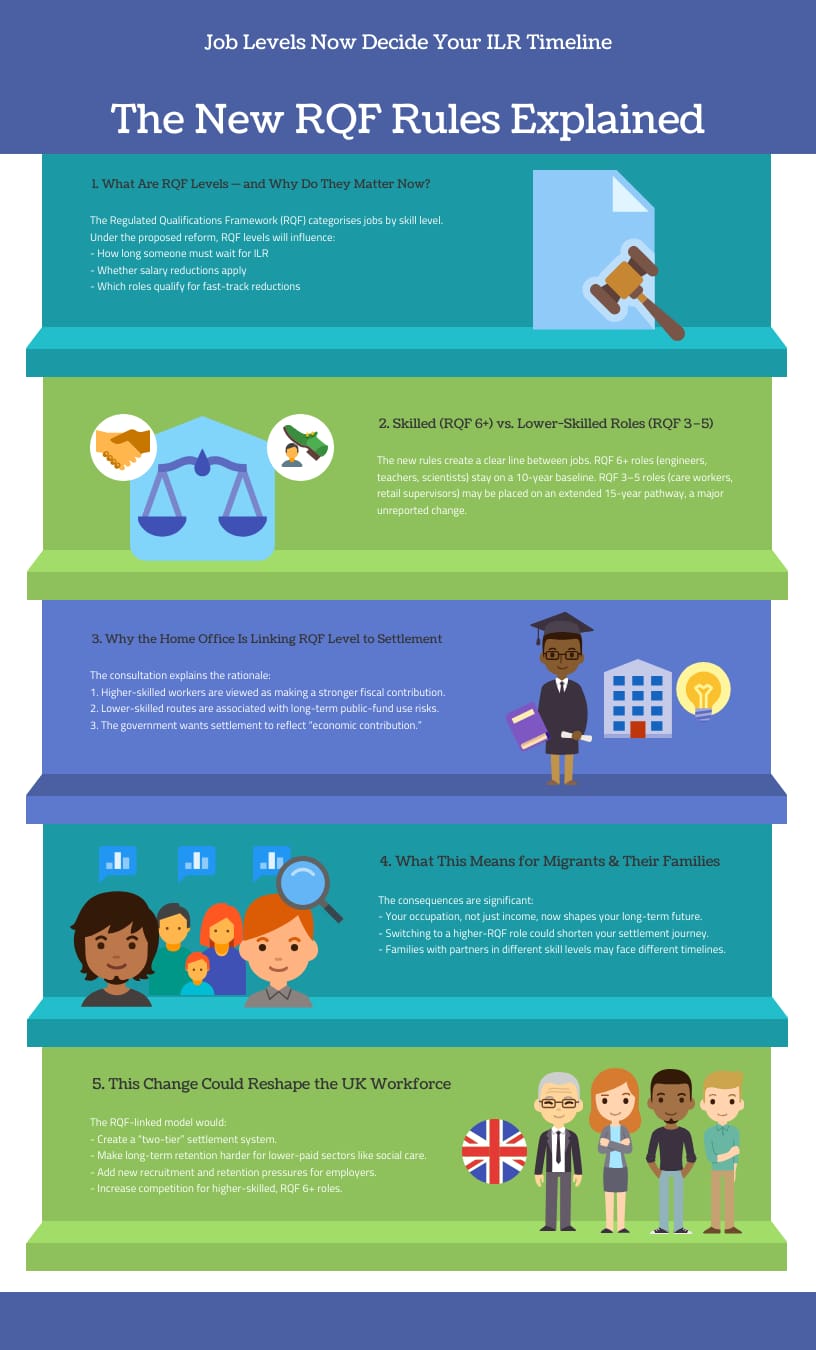
1. What Are RQF Levels — and Why Do They Matter Now?
The Regulated Qualifications Framework (RQF) categorises jobs based on skill level and qualification level.
Under the proposed settlement reform, RQF levels will influence:
- How long someone must wait for ILR
- Whether salary reductions apply
- Which workers face extended settlement timelines
- Which roles qualify for fast-track reductions
This is a major shift from the current system, where all Skilled Workers — regardless of role — follow the same 5-year settlement pathway.
2. Skilled (RQF 6+) vs. Lower-Skilled Roles (RQF 3–5)
The new rules draw a hard line between higher-skilled and lower-skilled jobs:
RQF 6 and above (high-skilled roles)
Examples:
✔️ Engineers
✔️ Teachers
✔️ Registered nurses
✔️ IT professionals
✔️ Scientists
✔️ Financial analysts
✔️ Managers and senior professionals
👉 These roles stay on the new 10-year baseline and can earn reductions.
RQF 3–5 (lower-skilled roles)
Examples:
✔️ Care workers
✔️ Childcare workers
✔️ Retail supervisors
✔️ Hospitality roles
✔️ Construction trades
✔️ Warehouse jobs
👉 These roles may be placed on an extended 15-year pathway — even if the worker meets all other requirements.
This is one of the biggest changes — and one that has not been widely reported.
3. Why the Home Office Is Linking RQF Level to Settlement
The consultation explains the rationale:
- Higher-skilled workers are viewed as making a stronger fiscal contribution.
- Lower-skilled routes (especially care work) are associated with long-term public-fund use risks.
- The government wants settlement to reflect “economic contribution” as a measurable standard.
This marks a fundamental shift in immigration philosophy:
🔄 From:
"Time in the UK automatically leads to settlement."
➡️ To:
"Your profession and contribution determine your settlement timeline."
4. This Is Not Yet Final — But It Is a Published Proposal
Everything written above comes directly from official sources.
The government has not finalised:
- Which RQF 3–5 roles will be included
- Whether the 15-year timeline will apply to all lower-skilled roles
- How reductions will interact with a longer baseline
Those decisions will come after the public consultation closes in mid-February 2026.
But the direction of travel is unmistakable:
👉 Lower RQF level = longer route to settlement (proposed).
5. What Migrants and Employers Should Take Away Today
For migrants in care, retail, hospitality, childcare, and service roles:
You may face longer settlement timelines under the proposed rules.
Pay, integration, and contribution may still earn reductions — but the baseline itself is under review.
For skilled workers in RQF 6+ roles:
You remain on the 10-year default, with potential reductions for high earners, volunteers, or public-service professionals.
For employers:
You may need to rethink long-term workforce planning, particularly in:
- Social care
- Hospitality
- Logistics
- Childcare
- Retail
Recruitment strategies and retention models may need to adapt.
6. What This Means for Migrants & Their Families
The consequences are real and immediate:
- Your occupation, not just your income, now shapes your long-term future.
- Switching to a higher-RQF role could significantly shorten your settlement journey.
- Families where partners work in different skill levels may face different timelines.
With dependants assessed independently in the new model, RQF levels could directly influence whether families settle together or at different times.
7. This Change Could Reshape the UK Workforce
If implemented, the RQF-linked settlement model would:
🔹 Create a clearer “two-tier” settlement system
Highly skilled roles → 10-year baseline
Lower-skilled roles → potentially 15-year baseline
🔹 Make long-term retention harder for lower-paid sectors
This includes social care — already facing chronic shortages.
🔹 Add new pressures for employers
Recruitment, retention and workforce planning will need to adapt.
🔹 Increase competition for higher-skilled, RQF 6+ roles
Migrants may shift career paths to reduce settlement timelines.
This is not simply an immigration technicality — it is a labour-market redesign.
Final Thoughts
The UK’s settlement reform is much more than a timeline change.
By tying settlement to RQF skill levels, the Home Office is reshaping the long-term immigration landscape — potentially creating:
- Two classes of workers
- Separate settlement timelines
- A direct link between job level and long-term residency
As reforms progress, one thing is clear:
📌 Skill level will become one of the most important factors in determining your future in the UK.
If you or your employees fall into RQF 3–5 roles, now is the time to understand the implications and prepare for potential changes in 2026.