





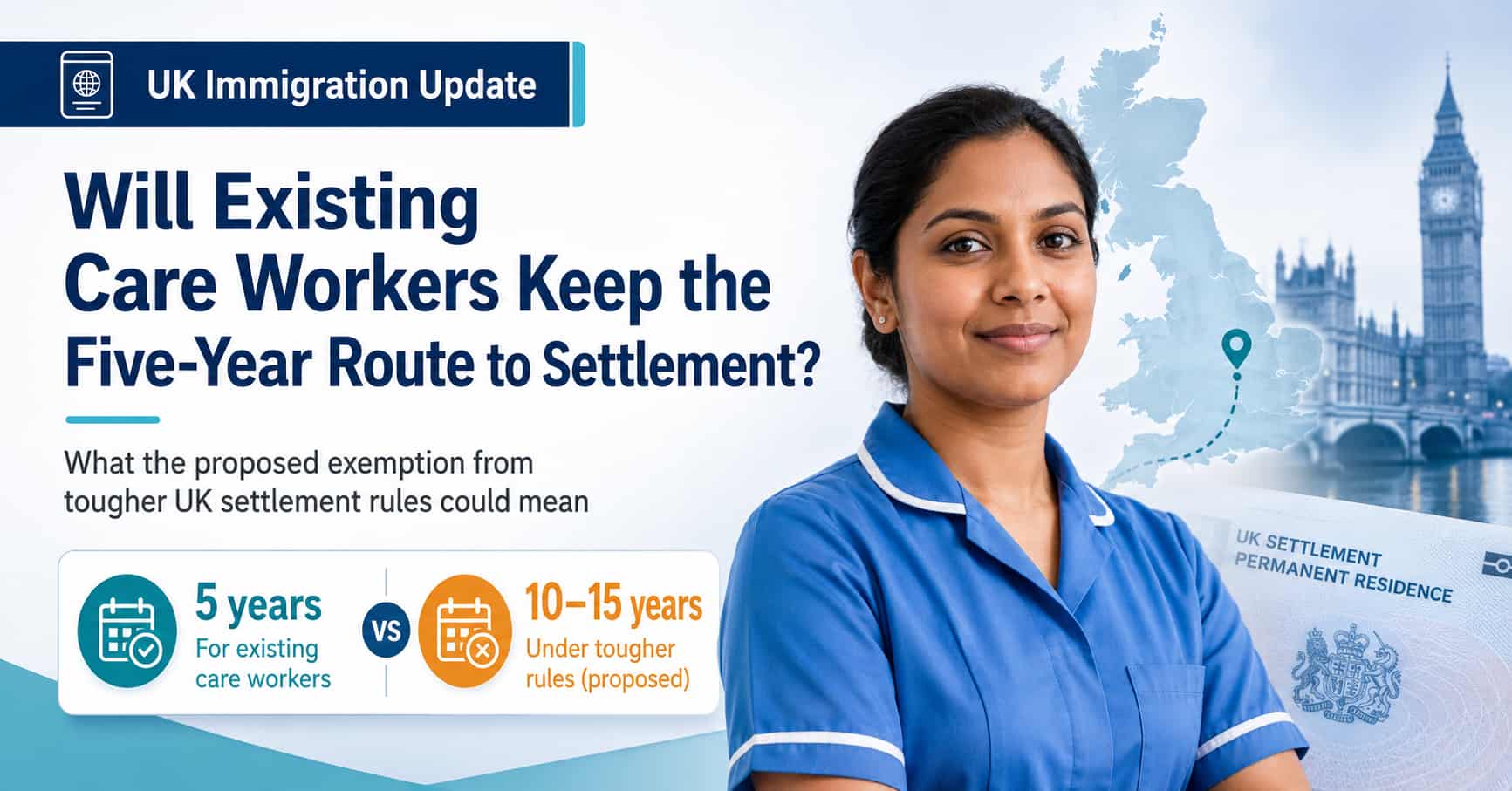
Recent reports suggest that the UK Government may be considering an exemption for care workers who are already living and working in the UK from some of the proposed changes to the settlement system.
According to a report published by The Guardian on 24 July 2026, the Government is considering whether existing care workers should be protected from stricter requirements for obtaining indefinite leave to remain.
If introduced, this could be a significant development for thousands of care workers, their families and employers across the social care sector.
Why This Issue Matters
Many care workers came to the UK under the Health and Care Worker route with the expectation that they could become eligible for settlement after completing five years of lawful residence, subject to meeting the relevant requirements.
The Government’s proposed earned settlement model could increase the standard qualifying period for indefinite leave to remain from five years to ten years for many migrants. Certain lower-paid workers may face an even longer qualifying period.
The concern is that these changes could potentially apply not only to future applicants but also to people who are already in the UK and progressing towards settlement under the current system.
For those workers, this is not simply a technical change to immigration policy. It could significantly affect their long-term plans, financial commitments, family arrangements and confidence in building a permanent future in the UK.
What the Reported Exemption Could Mean
The reported proposal appears to involve applying the new settlement requirements to future arrivals while allowing existing care workers to remain under the current arrangements.
This could mean that a care worker who is already in the UK and working lawfully under the Health and Care Worker route may still be able to qualify for settlement after five years, rather than being moved onto a ten-year or longer route.
However, it is important to emphasise that no such exemption has yet been formally introduced into the Immigration Rules.
At this stage, it remains a reported proposal under consideration. Care workers should therefore not assume that the existing five-year route has already been protected.
Why Care Workers May Receive Special Protection
The UK social care sector remains heavily dependent on migrant workers. Care workers provide essential support to elderly people, disabled individuals, people with complex medical needs and families who rely on professional care services.
The sector has also faced continuing difficulties with recruitment and staff retention. If existing care workers believe that their route to settlement may suddenly become substantially longer, some may reconsider whether they can continue building their future in the UK.
This could lead to experienced workers leaving their employers, moving away from the care sector or leaving the UK altogether. Such an outcome could place additional pressure on care homes, local authorities, hospitals and the wider health and social care system.
The possibility of an exemption may therefore reflect both concerns about fairness to existing workers and the need to maintain stability within the care workforce.
The Question of Fairness
There is a clear difference between introducing new rules for future applicants and changing the position of people who have already moved to the UK under an existing immigration framework.
A future applicant can consider the new requirements before deciding whether to come to the UK. An existing worker may already have relocated their family, started employment, placed children in school, paid substantial visa fees and organised their life around the expectation of a five-year route to settlement.
Changing the qualifying period after a worker has already made that commitment raises important questions about fairness, legal certainty and legitimate expectations.
Many would argue that people who entered the UK under a five-year route should be allowed to complete that route, provided they continue to meet all relevant immigration requirements.
Important Questions Still Need to Be Answered
Even if the Government decides to introduce an exemption, the wording of the final rules will be crucial.
It will be necessary to clarify who will be treated as an existing care worker. The relevant date could be the date of the Certificate of Sponsorship, the visa application, the visa grant, the worker’s arrival in the UK or the date on which the new rules take effect.
The Government will also need to clarify which occupations will be covered. An exemption may apply only to care workers and senior care workers, or it may extend more widely to other roles under the Health and Care Worker route.
Further clarification will also be required for workers who change employers, move between occupation codes or experience a break in sponsorship. It will also be important to confirm whether dependants will receive the same transitional protection as the main applicant.
Most importantly, the Government must explain whether an exemption would preserve the existing five-year route in full or simply provide a shorter qualifying period than the proposed ten-year or fifteen-year route.
What Existing Care Workers Should Do
Existing care workers should continue to comply fully with the conditions of their current immigration permission.
They should retain copies of their Certificates of Sponsorship, employment contracts, payslips, bank statements, immigration documents and records of any changes in employer or occupation.
They should also maintain accurate records of their absences from the UK, as these may remain relevant when applying for settlement.
Until the Government publishes its final decision and introduces formal changes to the Immigration Rules, workers should avoid making major immigration decisions solely on the basis of media reports.
A Positive Development, but Not Yet a Confirmed Rule
The possibility of protecting existing care workers is a positive sign. It suggests that the Government may be considering the practical impact of retrospective changes on workers who have already made significant personal and professional commitments in the UK.
However, the position remains uncertain until the Government publishes the final policy and confirms the applicable transitional arrangements.
Existing care workers need a clear and reliable route to settlement, employers need confidence that experienced staff will remain in the sector, and the social care system needs a stable and sustainable workforce.
The key question is whether people who entered the UK under a five-year settlement route should be allowed to complete that journey under the rules they relied upon.