




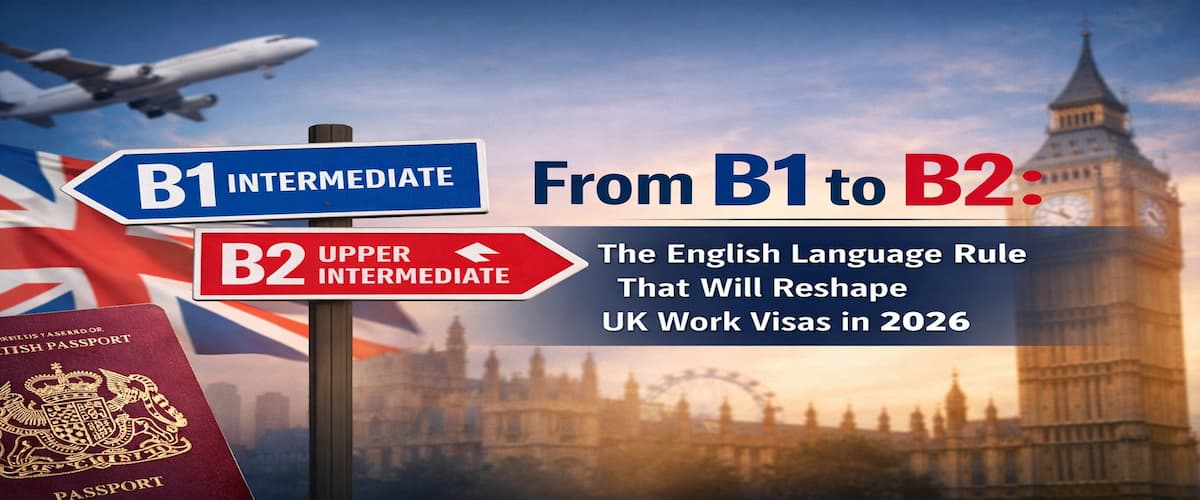
From 8 January 2026, the UK will introduce higher English language requirements for key economic migration routes.
What the New B2 Standard Means from 8 January 2026
From 8 January 2026, the UK government will introduce significantly higher English language requirements for several key economic migration routes. This change forms part of a broader policy shift aimed at strengthening integration, workplace effectiveness, and long-term contribution to the UK economy.
While the headline change is simple — B2 instead of B1 — the practical implications for migrants, graduates, employers, and sponsors are substantial.
This article explains what is changing, who is affected, who is protected, and what applicants and employers should do now.
1. What Exactly Is Changing?
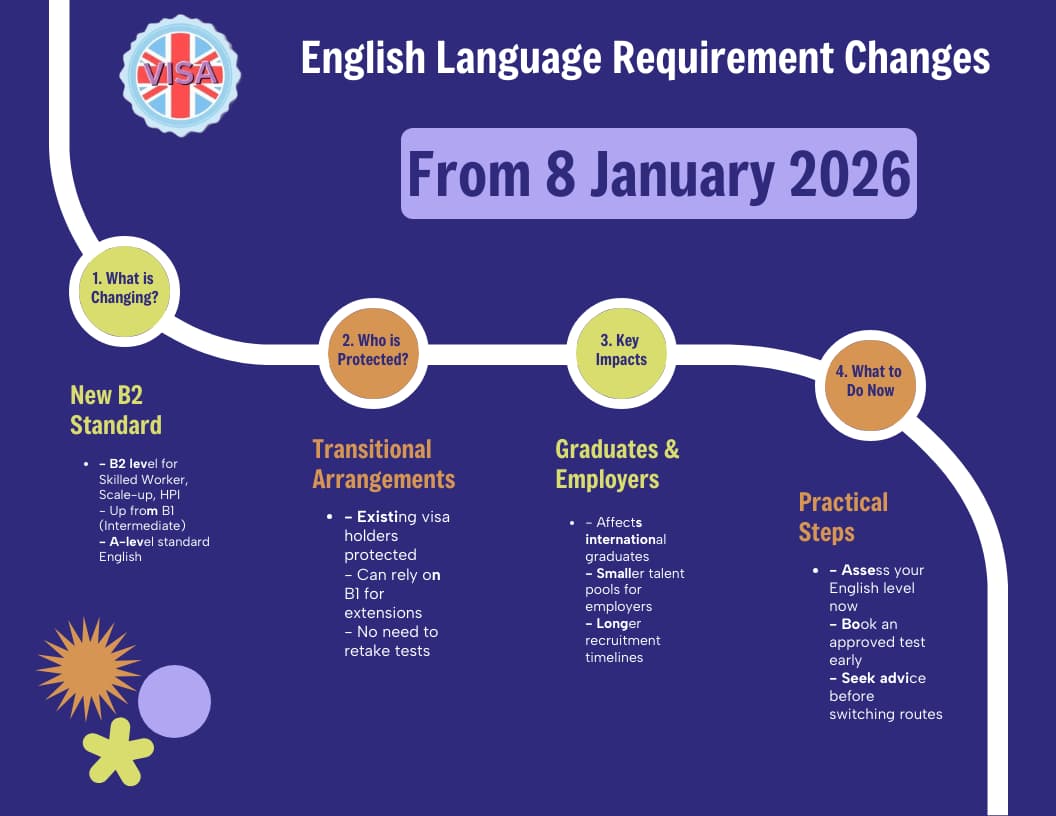
Under the new rules, new applicants under the following routes must demonstrate English language ability at level B2 (Upper Intermediate):
- Skilled Worker
- Scale-up Worker
- High Potential Individual (HPI)
This represents an increase from the current B1 (Intermediate) requirement.
In practical terms, B2 English means an applicant can:
- Communicate clearly and spontaneously with native speakers
- Participate effectively in professional discussions
- Understand complex texts and workplace instructions
- Write clear, detailed reports and correspondence
The government has described this as being broadly equivalent to A-level standard English.
2. When Does the Change Apply?
- Effective date: 8 January 2026
- Applies to:
- New overseas applicants
- Applicants switching into these routes from within the UK on or after this date
The rules are not retrospective.
3. Who Is Protected Under Transitional Arrangements?
One of the most important aspects of the change is the transitional protection for existing migrants.
✔ Existing visa holders
Individuals already in the UK on:
- Skilled Worker
- Scale-up
- High Potential Individual
can continue to rely on B1 English when applying for:
- Extensions on the same route
- Settlement applications where English has already been met
They will not be required to:
- Retake an English test at B2
- Upgrade their English level mid-route
⚠️ Important limitation
If an individual switches into a different route that newly requires B2, the higher standard may apply.
4. Impact on Graduates and Switching Applicants
This change will be particularly significant for international graduates.
Many graduates currently:
- Complete their studies in English
- Meet B1 requirements
- Plan to move into Skilled Worker or Scale-up roles after graduation
From January 2026:
- Meeting degree-level study requirements may not automatically satisfy B2
- Some graduates may need to sit a fresh English test
- Timing of visa switches will become more critical
This introduces:
- Additional cost
- Potential delays
- Strategic decision-making around when to switch visas
5. Impact on Employers and Sponsors
For UK employers, especially sponsor licence holders, the change has operational consequences.
Employers should expect:
- Smaller eligible talent pools in the short term
- Longer recruitment timelines
- Increased failed or delayed visa applications due to English test issues
Sponsors will need to:
- Check English language compliance earlier in recruitment
- Avoid issuing Certificates of Sponsorship before confirming B2 eligibility
- Build English testing timelines into onboarding plans
This change comes alongside:
- Increased Immigration Skills Charge
- Stricter sponsor compliance enforcement
- Greater scrutiny of genuine skill levels
Together, these signal a higher-threshold sponsorship environment.
6. Why Is the Government Doing This?
The policy rationale is clear:
- Improve workplace communication
- Enhance integration outcomes
- Reduce under-employment and skills mismatch
- Ensure economic migrants can operate effectively at professional levels
The government has consistently stated that economic migration should be selective, not merely numerical.
English language ability is now being treated as a core economic competence, not a basic entry requirement.
7. What Should Migrants Do Now?
If you are planning to apply under one of the affected routes in 2026:
Practical steps:
- Assess your English level now
- Book an approved English test early if B2 may be required
- Consider bringing forward applications where lawful and appropriate
- Seek advice before switching routes
Poor timing alone could mean:
- Failing a visa application
- Losing job offers
- Falling out of status
8. Key Takeaways
- From 8 January 2026, B2 English will be mandatory for new applicants under major work routes
- Existing visa holders are protected for extensions on the same route
- Graduates and switchers will be most affected
- Employers must adapt recruitment and sponsorship processes
- Early planning is now essential
Final Thought
This change extends beyond the realm of language assessments; it represents a significant evolution of the United Kingdom’s economic migration framework. This transformation increasingly prioritises preparedness, adherence to regulations, and sustained contributions to the economy.
Those who plan early will adapt smoothly. Those who do not may face unnecessary barriers.