






On Friday, 13 March 2026, the UK Parliament’s Home Affairs Committee published its report examining the Government’s proposed “Earned Settlement” reforms—a set of changes that could represent one of the most significant shifts in the UK immigration system in decades.
For decades, the UK’s immigration framework has operated on a relatively clear principle: most migrants who contribute to the economy and comply with immigration rules can qualify for Indefinite Leave to Remain (ILR) after five years.
Under the Government’s new proposals, that system could change dramatically.
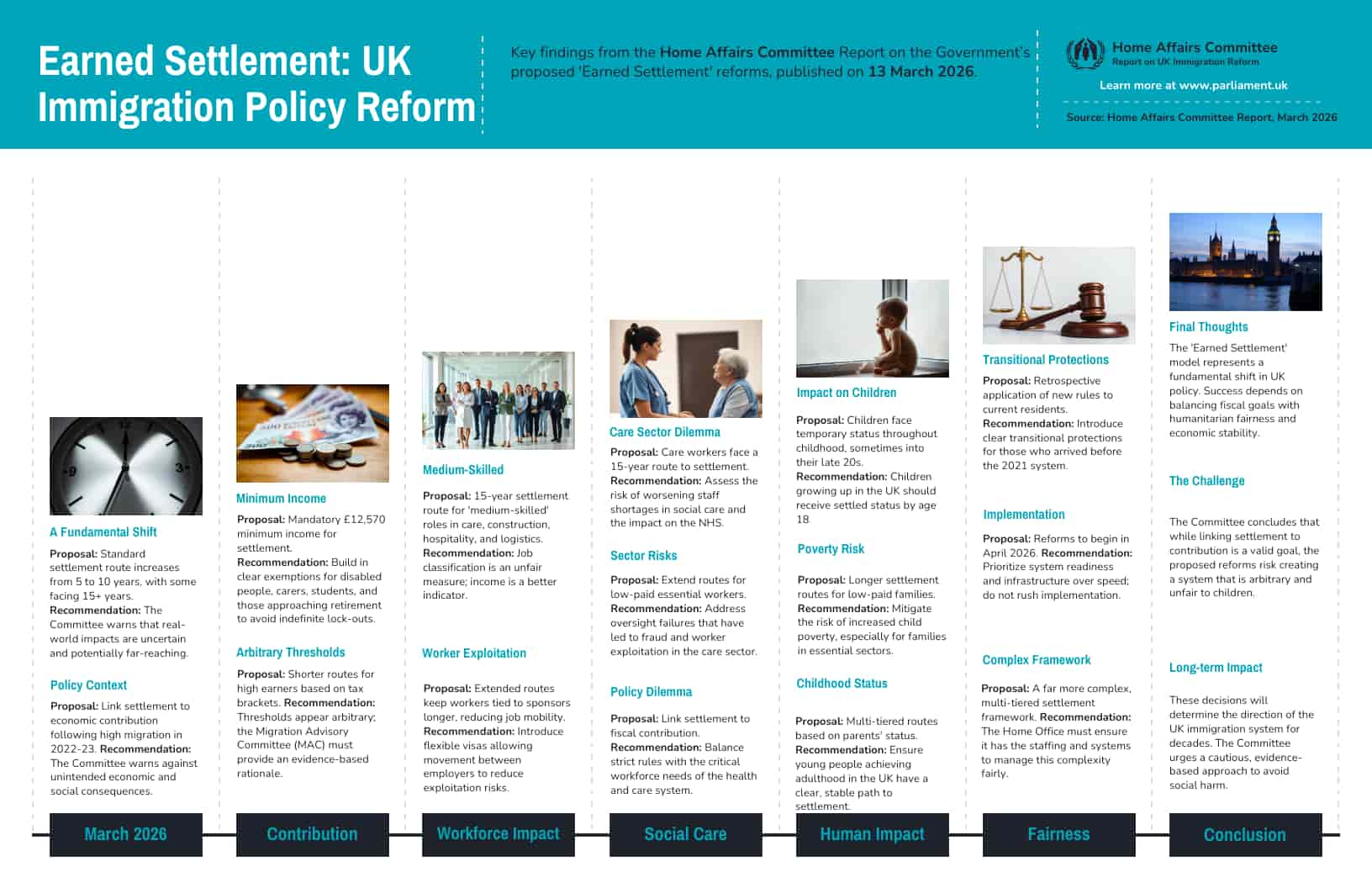
A Fundamental Shift: From 5 Years to 10 Years
The Government has proposed a new “Earned Settlement” model, where the standard route to settlement would increase from five years to ten years.
In addition, settlement timelines could vary depending on a person’s contribution to the UK, including their income, English language ability, and employment history.
Some migrants may qualify sooner.
Others could face significantly longer routes to settlement—up to 15 years or more.
The Home Affairs Committee acknowledges that the Government is responding to unprecedented immigration levels in recent years, particularly the increase in work migration between 2022 and 2023. The aim is to ensure that settlement reflects economic contribution and integration into British society.
However, the Committee also warns that the real-world impact of these changes is uncertain and potentially far-reaching.
Economic Contribution: A New Requirement for Settlement
One of the most significant proposals is the introduction of a mandatory minimum income requirement of £12,570 per year for migrants seeking settlement.
In principle, the Committee agrees that it is reasonable to expect those who wish to settle permanently in the UK to contribute economically.
But it also stresses an important point: not everyone can meet this requirement for legitimate reasons.
For example:
- People with disabilities
- Full-time carers
- Students
- Those approaching retirement
Without appropriate exemptions, such individuals could effectively be locked out of settlement indefinitely.
The Committee therefore recommends that clear and fair exemptions must be built into the system.
The Risk of Arbitrary Thresholds
Another controversial proposal involves reducing the settlement period for migrants who meet certain income thresholds.
For example:
- Higher earners could receive shorter routes to settlement
- Others could remain on the 10-year route
However, the Committee highlights a key concern: the proposed thresholds appear to be based on current tax brackets rather than a clearly defined economic rationale.
In other words, the policy risks being arbitrary rather than evidence-based.
The Committee therefore recommends that the Migration Advisory Committee (MAC) should advise the Government on appropriate thresholds.
A 15-Year Route for “Medium-Skilled” Workers
Perhaps the most controversial element of the proposals is the idea that medium-skilled workers could face a 15-year route to settlement.
This would affect thousands of workers in sectors such as:
- Social care
- Hospitality
- Construction
- Logistics
The Government’s justification is largely fiscal: these workers tend to earn less on average and may therefore draw more on public services once they qualify for settlement.
But the Committee strongly questions whether job classification (RQF levels) is the right measure of contribution.
Many people in so-called “medium-skilled” roles can earn very high salaries.
Using job categories rather than income could therefore produce unfair and illogical outcomes.
Worker Exploitation: A Serious Risk
The Committee also raises a critical warning about the risks of worker exploitation.
Under the current system, most Skilled Worker visa holders rely on employer sponsorship.
If settlement routes are extended to 10 or 15 years, workers may remain tied to their employers for much longer.
This could lead to:
- Reduced job mobility
- Slower career progression
- Greater vulnerability to exploitation
The Committee recommends that the Government explore more flexible visa arrangements, allowing migrants to move between employers more easily while still progressing towards settlement.
The Care Sector Dilemma
The report places particular emphasis on the adult social care sector, where overseas recruitment expanded rapidly after 2022.
The Home Office underestimated the demand for care workers, which led to far higher numbers of arrivals than expected.
At the same time, oversight failures resulted in fraud and worker exploitation.
The Government now faces a difficult policy dilemma:
If settlement rules remain unchanged, hundreds of thousands of care workers may qualify for settlement within a few years.
But if settlement routes are extended to 15 years, two outcomes are possible:
1️⃣ Workers leave the UK, worsening staff shortages in social care.
2️⃣ Workers stay but remain trapped in low-paid jobs for over a decade.
Neither outcome is ideal.
The Committee therefore urges the Government to carefully assess the impact of settlement reforms on the social care workforce, particularly given the sector’s importance to the NHS and the wider health system.
The Impact on Children
One of the most powerful sections of the report concerns children growing up in the UK.
Under the proposed reforms, many children could spend their entire childhood with temporary immigration status.
In some cases, young people might not achieve settlement until their late twenties or early thirties, depending on their parents’ immigration status.
The Committee argues strongly that:
Children who arrive in the UK at a young age and grow up here should normally receive settled status by the age of 18.
It also warns that extending settlement routes could increase child poverty, particularly among families in low-paid sectors.
Transitional Protections: A Question of Fairness
Another key issue is whether the new rules should apply to migrants already living in the UK.
Many migrants made life decisions based on the expectation that settlement would be possible after five years.
Applying the new rules retrospectively could therefore raise serious fairness concerns.
The Committee recommends that the Government introduce clear transitional protections, particularly for migrants who arrived before the UK’s post-Brexit immigration system began in 2021.
Implementation: Don’t Rush Reform
Finally, the Committee warns against rushing implementation.
The Government has suggested that changes could begin as early as April 2026, but many elements of the policy remain unclear.
Given the complexity of the new system, the Committee stresses that:
It is more important to get the reforms right than to implement them quickly.
The Home Office must therefore ensure that it has the systems, staffing, and infrastructure required to administer what would be a far more complex settlement framework.
Final Thoughts
The proposed Earned Settlement model represents a fundamental shift in the philosophy of UK immigration policy.
The Government seeks to link settlement more closely to economic contribution and integration.
But as the Home Affairs Committee makes clear, the reforms could also carry significant economic, social, and humanitarian consequences.
The challenge now facing policymakers is to design a system that is:
- Fair to migrants already living in the UK
- Sustainable for public finances
- Supportive of key sectors such as social care
- Protective of children and families
Achieving that balance will not be easy.
But it will determine the future direction of the UK immigration system for decades to come.
Full report is available: Home Affairs Committee – Earned Settlement: Examining the Government’s proposed reforms