






One of the most misunderstood areas of UK immigration today is suitability — and in 2026 and beyond, it matters more than ever.
We regularly hear questions like:
“I had a parking fine — will this affect my ILR?”
“I missed a PCN — is this now a criminal issue?”
“Does the Home Office really check these things?”
Let’s break this down clearly, calmly, and honestly.
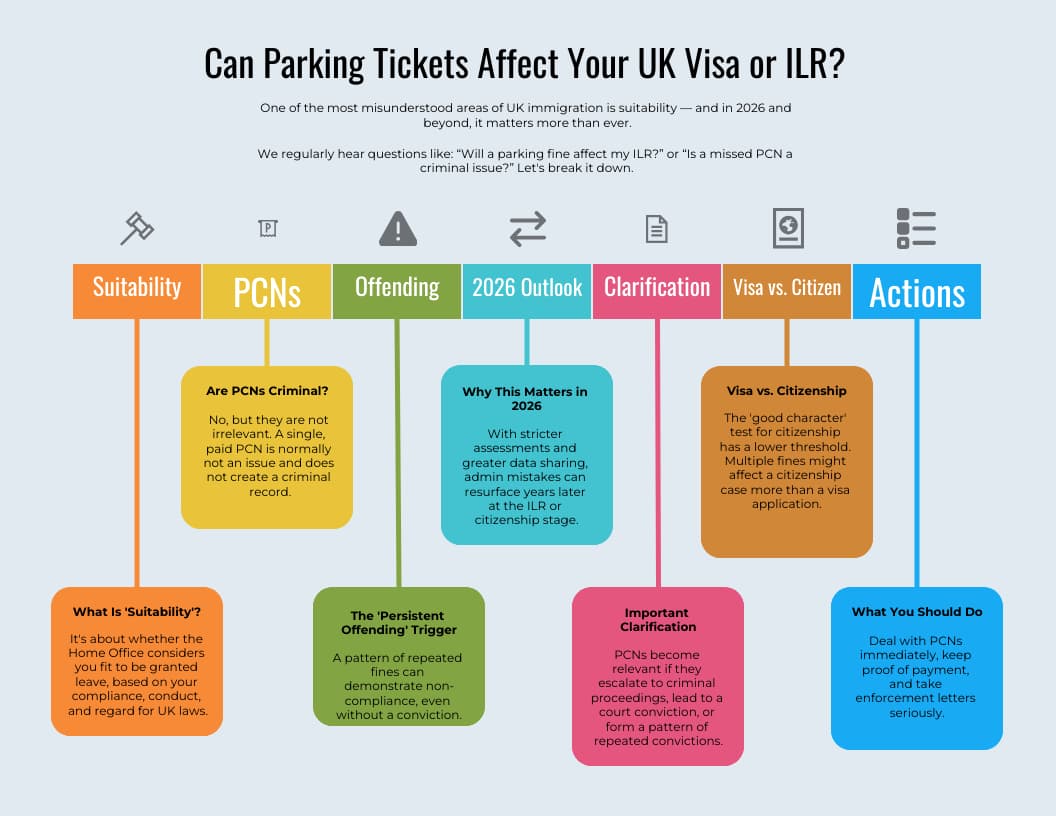
⚖️ What Is “Suitability” in UK Immigration?
Suitability is not about whether you qualify on paper.
It’s about whether the Home Office considers you fit to be granted leave — even if you meet every other requirement.
Under the current rules, applications can be refused where an applicant shows:
- persistent non-compliance
- disregard for UK laws
- poor immigration or general conduct
Suitability plays a major role in:
- Skilled Worker extensions
- ILR applications (SET(LR), SET(O))
- British citizenship (Good Character test)
This is where many applicants underestimate risk.
🚗 Are Parking Charge Notices (PCNs) Criminal?
No — but they are not completely irrelevant either.
| Type | What it is | Immigration impact |
| Parking Charge Notice (PCN) | Civil penalty | ⚠️ Usually low risk |
| Fixed Penalty Notice (FPN) | Minor offence, often civil | ⚠️ Context matters |
| Repeated unpaid penalties | Behaviour pattern | 🚨 Scrutiny risk |
A single, paid PCN is normally not an issue.
It does not create a criminal record and does not automatically affect a visa or ILR.
But immigration decisions are not made in isolation.
🔁 “Persistent Offending” – The Hidden Trigger
This is where many people misunderstand the rules.
Home Office guidance is clear on one point:
You do not need a prison sentence — or even a conviction — to fail suitability.
A person can be assessed negatively where there is evidence of:
- repeated fines
- repeated enforcement action
- ignoring penalties or legal obligations
Taken individually, each issue might look “minor”.
Taken together, they can demonstrate a pattern of behaviour — and patterns matter.
This is what the Home Office refers to as persistent offending or persistent non-compliance.
⚠️ Importantly:
- This does not mean one parking ticket = refusal
- It means repeated issues over time may attract scrutiny
🧠 Why This Matters More in 2026
The immigration system has changed — quietly but significantly.
We now have:
- longer settlement timelines
- stricter suitability and character assessments
- greater digital data sharing across government bodies
- more automated background checks
What once felt like a harmless admin mistake can now resurface years later, especially at ILR or citizenship stage.
Suitability looks at behaviour over time, not just whether you passed a test or earned enough salary.
📌 Important Clarification
Civil penalties like PCNs and most FPNs do not automatically fall under criminality.
PCNs or FPNs may become relevant only if:
- They escalate into criminal proceedings
For example, where an FPN is not complied with and leads to prosecution. - A conviction is recorded by a court
At that point, the Home Office assesses the conviction and sentence, not the original notice. - There is a pattern of repeated convictions
Multiple convictions for similar conduct may be assessed as persistent offending.
In other words, it is not the PCN or FPN itself, but what happens after it, that can bring Part Suitability into play.
Important Distinction: Visa Applications vs Citizenship
It is also important not to confuse visa suitability with the good character test for British citizenship.
Nationality guidance explicitly states that:
- a single FPN will not normally lead to refusal,
- but multiple FPNs over a short period may demonstrate a disregard for the law in citizenship cases.
This reflects the fact that:
- the citizenship “good character” test has a lower threshold, and
- visa refusal under Part Suitability requires a clearer link to criminality.
What may be relevant for citizenship is not automatically relevant for a visa or extension application.
✅ What You Should Do
If you’re on a UK visa — or planning ILR or citizenship:
✔ Deal with PCNs and FPNs immediately
✔ Keep proof of every payment
✔ Take enforcement letters seriously
✔ Be honest if asked — disclosure matters
✔ Get advice early if issues repeat
✔ Keep your paperwork organised
❌ Don’t rely on “it’s only civil”
❌ Don’t let minor issues grow into major problems
🧠 Final Thought
UK immigration today goes beyond simply meeting requirements related to salary, English proficiency, or the length of time spent in the UK. It also focuses on your behaviour over time—specifically, your compliance, credibility, and the history you create. This is what often leads to issues for people, frequently when it’s too late to address them.