





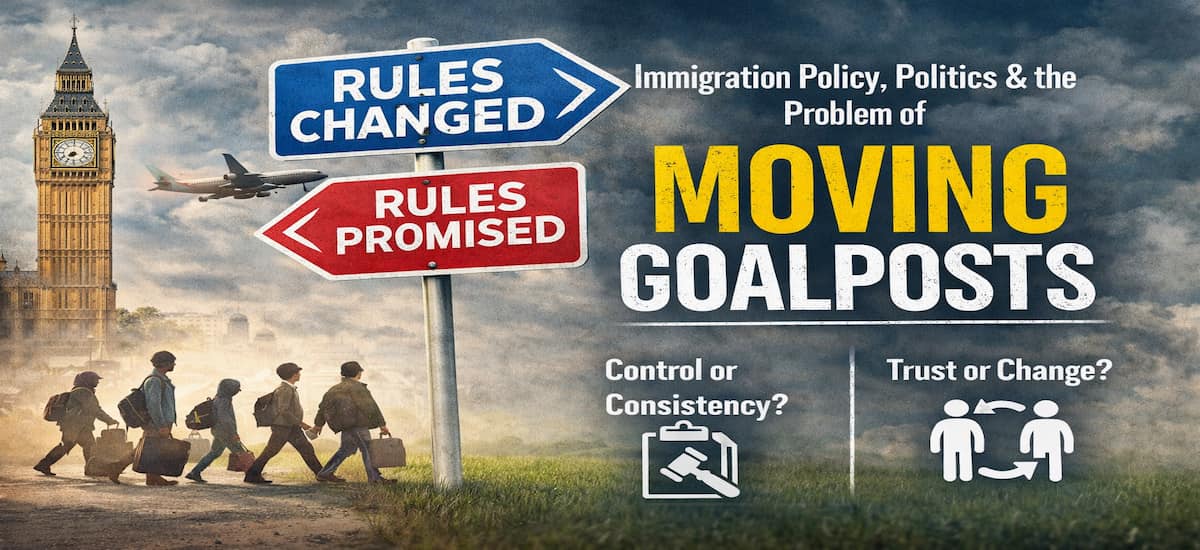
Something important is happening in UK immigration policy right now — and it goes beyond just rules and timelines.
It’s about trust.
The government is pushing ahead with plans to make settlement harder to achieve. The headline change is clear: moving from a five-year route to settlement to a ten-year one for most migrants, with even longer timelines being discussed in some cases.
On the surface, it’s a move towards greater control. A response to public concern. A reset of the system.
But the reaction has told a different story.
What’s striking is that the loudest resistance hasn’t come from opposition parties — it’s come from within. Over 100 MPs, peers, and union voices have raised concerns. And Angela Rayner put it in a way that cut through the noise:
“We cannot talk about earning a settlement if we keep moving the goalposts.”
That line has stuck — because it gets to the heart of the issue.
This isn’t really about whether immigration policy should be tougher or softer.
It concerns whether the rules should change after individuals have already committed to them. Behind every policy shift are real people: professionals who relocated their careers, families who built their lives here, and employers who made long-term hiring decisions.
All based on a system that promised a clear pathway.
Now imagine that pathway quietly stretching from five years to ten — not just for future applicants, but potentially for those already halfway through.
That’s where discomfort turns into concern.
Supporters of the changes argue that longer settlement routes are necessary to ensure the system is sustainable, particularly after years of high net migration. They believe tighter rules are essential to maintain public confidence and manage pressure on public services.
To be clear, the government hasn’t backed away from its direction. The ten-year route is still very much on the table. But there are clear signs of movement beneath the surface.
We are hearing discussions about exemptions, transitional arrangements, faster routes for certain sectors, and protections for those nearing settlement. In other words, there is a focus on flexibility.
This is not a dramatic U-turn; rather, it is something more subtle and potentially more important: a policy that is being reshaped in real time.
This illustrates a larger trend in the direction of immigration policy.
It’s no longer being set in a straightforward manner; instead, it is being negotiated amid political pressure, public sentiment, economic needs, and internal disagreements.
What does this mean for the outcome?
It does not necessarily lead to a stricter system, nor does it guarantee a more lenient one. However, it almost certainly results in a more complex system.
Here’s the real challenge: tightening a system is one thing; maintaining trust in it is quite another. Once people begin to feel that the rules can change while they are following them, confidence doesn’t just diminish—it fractures. Trust is crucial in immigration.
So, the fundamental question isn’t whether the system should be tougher. Instead, it is this:
👉 Can it still be predictable?
For those building their lives around it, that predictability matters most.