






On 17th December 2025, the Migration Advisory Committee (MAC) delivered one of its most consequential interventions in UK immigration policy in recent years. Published alongside its Annual Report, a formal letter from the Chair, Professor Brian Bell, to the Home Secretary pulls together the Committee’s thinking on salary thresholds, fiscal impacts, worker protection, and integration—and does so with unusual clarity.
Taken together, the report and the letter amount to a coherent policy message: immigration rules should be economically rational, evidence-led, and honest about trade-offs—without pretending that every route can or should pay for itself.
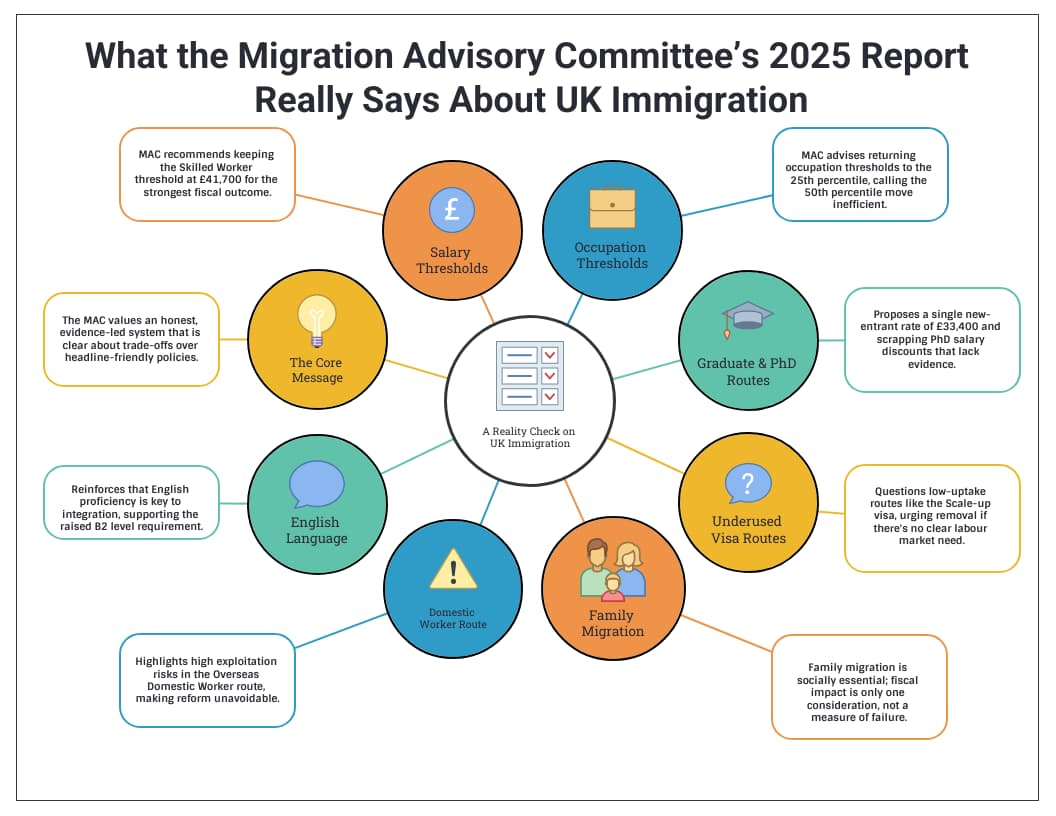
Here’s what stands out — and why it matters.
Salary thresholds: clarity instead of escalation
The MAC recommends keeping the Skilled Worker salary threshold at £41,700.
Not because it’s “tough”. Not because it sounds good in a headline. But because, of all the options tested, this level:
- Delivers the strongest fiscal outcome
- Allows Industrial Strategy sectors to recruit
- Reflects regional wage variation
- Avoids unintended consequences for younger workers
Crucially, the MAC rejects the idea that simply raising thresholds further is an effective migration control. Higher isn’t always better — and in this case, it would be less fiscally positive.
Occupation thresholds: a quiet but important reset
The April 2024 move to raise occupation-specific thresholds to the 50th percentile comes in for sharp criticism.
The MAC’s view about what happened:
- It blocked lower-paid roles within occupations
- It did little to protect UK workers
- It was an inefficient way to reduce net migration
The recommendation: return occupation thresholds to the 25th percentile, where they actually serve their intended purpose.
Graduates in, gimmicks out
To keep the system open to early-career talent, the MAC recommends:
- A single new-entrant rate of £33,400
At the same time, it cuts complexity:
- Scrap the PhD salary discount
- End the postdoc discount if £41,700 is adopted
Why? Because the evidence shows PhD holders don’t earn less than average workers. Discounts without evidence don’t belong in a serious system.
Underused routes and hard choices
The MAC questions the value of low-uptake routes like the Scale-up visa.
With minimal use, the message is clear:
Don’t maintain or create routes unless there is a clear labour market need.
Complexity without impact helps no one.
Family migration: fiscally mixed, socially essential
One of the most nuanced parts of the Annual Report tackles family visas.
The findings:
- Family migrants are fiscally positive in the early years
- On average, they are negative over a lifetime
- The top 10% of earners remain fiscally positive
And the MAC is explicit: this is not a failure. Family migration is not an economic route — and fiscal impact is only one consideration. Pretending otherwise leads to bad policy.
Overseas Domestic Workers: a route that enables abuse
The MAC also highlights real risks of exploitation in the Overseas Domestic Worker route:
- Weak enforcement
- Limited data on employers
- High worker isolation
It stops short of calling for abolition — but makes clear that reform is unavoidable if the route continues.
English language: integration’s missing pillar
Finally, the MAC reinforces something often underplayed: English language proficiency matters.
Stronger language skills are linked to:
- Higher employment
- Higher earnings
- Better integration
This evidence underpins the government’s decision to raise the Skilled Worker English requirement to B2 level from January 2026.
Final thoughts
What the MAC offers in 2025 isn’t a grand theory of immigration — it’s something more valuable: honesty. Not every visa route will be fiscally positive. Not every problem can be solved by raising thresholds. And not every trade-off can be avoided. A system built on evidence, clarity and purpose may be less headline-friendly, but it’s far more likely to work.