






On 23 June 2026, the House of Lords Justice and Home Affairs Committee published its report on the Government’s proposed Earned Citizenship reforms.
For many migrants, families, refugees, employers and immigration professionals, this report is an encouraging development.
The key message is clear:
The Committee does not support extending the standard qualifying period for Indefinite Leave to Remain from 5 years to 10, 15 or 20 years.
That matters.
For thousands of people already living, working, studying, raising families and contributing to the UK, settlement is not just a legal status.
It is stability.
It is certainty.
It is the ability to plan a future without constantly worrying that the rules may change again.
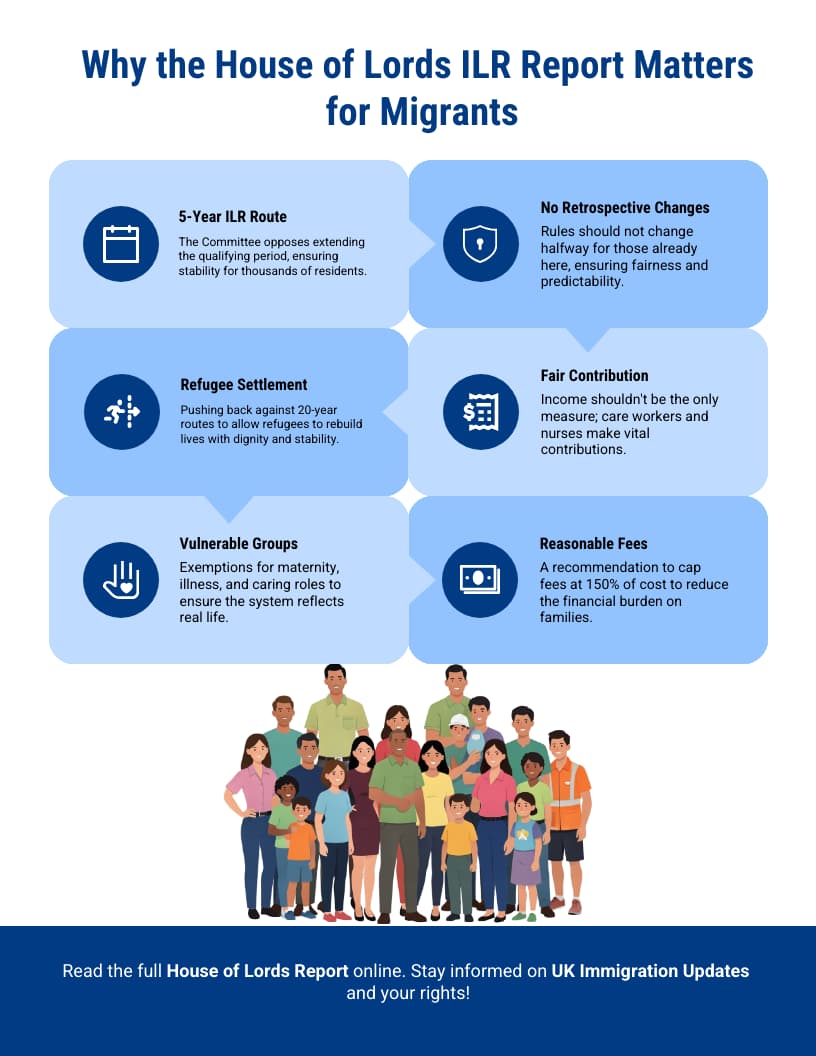
1. The 5-Year ILR Route Should Not Be Extended
One of the biggest concerns for migrants has been the possibility that the standard qualifying period for settlement could increase from 5 years to 10 years or even longer.
The Committee has clearly pushed back against this.
It warned that making people wait longer for settlement could create:
- more uncertainty
- greater financial pressure
- weaker integration
- higher risk of poverty
- more people falling into irregular status
- increased stress for families
- a less attractive UK immigration system for global talent
This is an important point.
People integrate better when they feel secure.
If someone is living in constant uncertainty, paying repeated visa fees, worrying about changing rules and delaying major life decisions, that does not help integration.
It makes life harder.
2. Refugees Should Not Face a 20-Year Route to Settlement
The Committee also raised serious concerns about the proposal for refugees to face a 20-year route to settlement, with repeated reviews of their refugee status.
This is important.
Refugees are often rebuilding their lives after trauma, conflict or persecution.
A system that keeps them in uncertainty for decades risks making integration much harder.
People need security to work, study, support their families and contribute fully to society.
For refugees, settlement is not just about immigration status.
It is about being able to rebuild a life with dignity and stability.
3. No Retrospective Changes
Another very important recommendation is that any new ILR rules should not apply retrospectively.
This is especially important for people who are already in the UK on a route to settlement.
Many migrants came to the UK based on the rules in place at the time.
They accepted jobs.
They moved their families.
They paid high visa fees.
They built careers.
They enrolled children in schools.
They made long-term plans.
Changing the rules halfway through that journey would be deeply unfair.
The Committee recognised this and described retrospective changes as “manifestly unfair.”
That phrase is important.
It reflects what many migrants have been feeling: that the immigration system must be predictable and fair.
People should not have the goalposts moved after they have already committed years of their lives to the UK.
4. ILR and Public Funds Could Be Treated Separately
The Committee suggested that the Government could consider separating two questions:
- when a person should qualify for ILR
- when a person should have access to public funds
This could mean keeping the 5-year ILR route, while continuing restrictions on access to public funds until 10 years’ residence or British citizenship.
This proposal will need careful discussion.
It may still concern some migrants, particularly families and vulnerable people.
However, it is very different from requiring everyone to wait 10 years or more before they can obtain settlement.
For many migrants, ILR provides an important level of security even if access to public funds remains restricted for longer.
5. Income Should Not Be the Only Measure of Contribution
The report also raises concerns about using income thresholds to decide who can qualify for settlement sooner.
This is very important.
A person’s contribution to the UK cannot always be measured by salary alone.
Many people make a huge contribution to the UK while earning modest salaries, including:
- care workers
- nurses
- teachers
- researchers
- charity workers
- hospitality workers
- regional workers
- parents and carers
The Committee recommended that any income-based rules should be reviewed properly, with advice from the Migration Advisory Committee.
It also said the Government should consider regional differences, public finances and other forms of contribution.
That is a more balanced approach.
A migrant’s value should not be judged only by their payslip.
6. Protection for Vulnerable Groups
The Committee also recommended exemptions from strict income requirements for certain groups.
This includes people affected by:
- maternity leave
- long-term illness
- disability
- unpaid caring responsibilities
- other vulnerable circumstances
This is very important.
Immigration rules should reflect real life.
People should not be punished because they have had a child, become unwell, developed a disability, or taken time away from paid work to care for a loved one.
A fair system must allow room for human circumstances.
7. Migrant Workers Need Better Protection from Sponsor Abuse
The report also highlights concerns about visa sponsor abuse.
This is one of the most practical issues for many Skilled Worker visa holders.
Many migrant workers are tied to a specific employer. If that employer exploits them, underpays them, threatens them or withdraws sponsorship, the worker’s immigration status can be placed at risk.
That creates a serious power imbalance.
The Committee supported exploring whether visas could be linked to sectors rather than individual sponsors.
This could give migrant workers more freedom, reduce exploitation and help them participate more confidently in the UK labour market.
For many workers, especially in lower-paid sectors, this could be an important protection.
Migrants should be able to work hard and contribute without living in fear that one employer can control their entire future in the UK.
8. Children Should Not Be Left in Limbo
One of the most human parts of the report is its focus on children.
The Committee said that children who grow up in the UK from a young age should normally receive settled status by the age of 18.
This is a powerful recommendation.
A child who has grown up in the UK, gone to school here, made friends here and built their identity here should not enter adulthood with uncertain immigration status.
For many children, the UK is the only home they truly know.
The immigration system should recognise that.
Children should not be punished for decisions made by adults or left in long-term uncertainty because of complex immigration rules.
9. English Language Support Should Be Improved
The Committee also called for better ESOL provision through a national strategy.
This is positive because integration is not only about immigration rules.
People integrate better when they can access English language classes, understand public services, communicate confidently and participate fully in society.
If the Government wants migrants to integrate, it must also support them with the tools to do so.
Expecting people to improve their English without providing enough accessible classes is not a serious integration strategy.
Support and responsibility must go together.
10. The Life in the UK Test Needs Reform
The Committee also criticised the Life in the UK Test.
It did not recommend scrapping the test completely, but it said the test needs urgent reform.
This will resonate with many people who have prepared for ILR or citizenship.
The current test often feels disconnected from real life in the UK.
The Committee suggested that the test should focus more on British values and practical knowledge of living in the UK.
It also suggested that courses could be offered as an alternative to the test.
That would make the process more meaningful.
Settlement and citizenship should assess genuine engagement with life in the UK, not just the ability to memorise facts for a multiple-choice exam.
11. Immigration Fees Should Be More Reasonable
One of the most welcome recommendations is that application fees should be capped at 150% of the actual administrative cost.
This would be a major improvement.
UK immigration fees are already very high.
Many families pay thousands of pounds in:
- visa application fees
- Immigration Health Surcharge fees
- legal fees
- repeated renewal costs
- settlement application fees
For families with children, the cost can be overwhelming.
High fees can trap people in financial pressure and make the journey to settlement much harder.
A fairer fee structure would make the system more humane and more accessible.
The report also recognises that very high fees can make the UK less attractive to global talent.
That matters for migrants, employers and the wider economy.
12. The Immigration System Needs to Be Simpler
The Committee also strongly criticised the complexity of the UK immigration system.
This will not surprise migrants, employers or immigration professionals.
The rules are often difficult to understand, even for experts.
For ordinary applicants, they can feel overwhelming.
Complex rules can lead to:
- mistakes
- delays
- refusals
- extra legal costs
- stress
- uncertainty
- unfair outcomes
A fair immigration system is not just about the rules.
It is also about how those rules are written, explained and applied.
If a system is so complex that even experts struggle with it, ordinary applicants cannot be expected to navigate it easily without fear of making a mistake.
13. The Home Office Needs Proper Capacity and Reform
The Committee also raised concerns about whether the Home Office can deliver major changes without additional pressure on staff, systems and applicants.
This is a crucial point.
More complex rules usually mean more complex applications.
More complex applications mean more documents, more checks, more delays and more pressure on caseworkers.
The Committee called for an independent review of Home Office operations, including staffing, processes and technology.
That is badly needed.
Migrants are often blamed for delays, but delays are also caused by systems that are under-resourced, complicated and difficult to manage.
A better immigration system needs better administration.
14. Major Changes Should Be Based on Evidence
The report also highlights a serious data gap.
The Committee raised concern that the Government does not have enough reliable data about migrant outcomes, exit checks and the wider impact of settlement policy.
This matters because major immigration reform should be based on evidence, not headlines.
The Committee recommended better data sharing across government and a proper impact assessment before major changes are implemented.
That is important.
Before changing people’s lives, the Government should be able to show clearly:
- what problem it is trying to solve
- what evidence supports the change
- who will be affected
- how families, employers and communities will be impacted
- whether the Home Office can actually deliver the new system
Good policy needs good evidence.
15. Citizenship Should Be Valued and Promoted
The Committee also emphasised that British citizenship should be valued more.
For many migrants, citizenship is the final step in building a secure and permanent future in the UK.
It is not just a passport.
It is belonging.
It is participation.
It is the ability to vote, engage fully in civic life and feel permanently part of the country.
The Committee’s message is that citizenship should be promoted and respected as an important step in integration.
That is a positive message for migrants who want to make the UK their long-term home.
Why This Report Is an Encouraging Development for Migrants
This report is encouraging because it recognises the real-life impact of immigration policy on migrants and their families.
It understands that migrants are not just statistics.
They are workers, parents, students, business owners, carers, taxpayers, neighbours, refugees rebuilding their lives and children growing up in British communities.
The report supports several important principles:
- settlement should remain realistic
- changes should not be retrospective
- refugees should not be left in uncertainty for decades
- families should not be punished unfairly
- migrant workers should be protected from exploitation
- children should have secure futures
- contribution should not be measured only by income
- English language support should be accessible
- the Life in the UK Test should be more meaningful
- fees should be more reasonable
- citizenship should be valued
- the immigration system should be simpler and fairer
- major reforms should be based on evidence
Most importantly, the report sends a clear message:
Keeping people insecure for longer does not help integration. Stability helps integration.
What Happens Next?
The Government now has two months to respond.
It is important to be clear: nothing has changed in law yet.
The current ILR rules remain in place for now.
This report does not automatically stop the Government from making changes.
However, it is an important development because it puts strong pressure on the Government to rethink its approach.
Migrants should not panic, but they should stay informed.
Employers should continue workforce planning carefully.
Families should continue preparing for settlement based on the current rules, while watching closely for the Government’s response.
The Committee also recommended that the Government publish a full impact assessment before implementing major changes.
That is only fair.
Reforms of this scale should be transparent, evidence-based and properly scrutinised.
Conclusion
The House of Lords Committee has delivered a clear and sensible message.
The UK needs an immigration system that is fair, predictable and workable.
Extending settlement from 5 years to 10 years or more would create uncertainty for people who are already contributing to the UK and building their lives here.
A better system should reward contribution, support integration and give migrants a genuine path to stability.
For migrants, this report is encouraging.
It does not mean the debate is over.
But it does mean that one of the strongest Parliamentary voices on this issue has recognised what many migrants already know:
You cannot build integration by keeping people in insecurity.
Stability matters.
Fairness matters.
Evidence matters.
And people who have made the UK their home deserve a settlement system they can trust.