






ILR Visa UK
UK ILR Rule Changes 2026
Last updated: April 2026
The UK government is planning significant changes to Indefinite Leave to Remain (ILR) rules from 2026, which may affect how and when migrants qualify for settlement.
Key proposed changes include:
- The standard 5-year ILR route may increase to 10 years.
- Introduction of a new "earned settlement" system.
- ILR eligibility based on income level, skills and employment, English language ability and contribution to UK society.
Should You Apply Before 2026?
If you are close to completing 5 years in the UK, it may be beneficial to apply for ILR before new rules are introduced.
Our experts can assess your eligibility and help you secure settlement under the current rules.
ILR Rules: Current vs Proposed (2026)
| Criteria | Current ILR Rules | Proposed ILR Rules (2026) |
|---|---|---|
| Time requirement | 5 years | 10 years (standard route) |
| System | Time-based | Contribution-based |
| Flexibility | Limited | Case-by-case assessment |
| Risk | Predictable | Potentially stricter |
Who Will Be Affected by ILR Changes?
The proposed ILR changes may impact:
- Skilled Worker visa holders.
- Dependants applying for ILR.
- Migrants on lower income thresholds.
- Individuals planning long-term UK settlement.
The UK Government has indicated that new ILR rules are expected to be implemented from Autumn 2026.
At the same time, recent reports suggest these immigration plans are facing political pressure to avoid retrospective application, meaning applying new rules to people already in the UK.
This indicates that some migrants may qualify for protection under the existing five-year regulations, while others may be affected based on forthcoming policy decisions.
Indefinite Leave to Remain Visa UK
Indefinite Leave to Remain (ILR) in the UK, also known as Permanent Residency or Settlement Visa, allows individuals who have legally lived in the UK for a certain period to apply for permission to settle permanently in the country. This is the final step for non-UK nationals before they can apply for British citizenship.
Getting Indefinite Leave to Remain (ILR) is a big milestone for many immigrants as it gives them the freedom to live and work in the UK without time limits.
ILR is granted to non-UK citizens allowing them to live, work and study in the UK without restrictions. It is a big step towards full British citizenship offering many benefits and security for those who qualify.
What is an Indefinite Leave to Remain Visa (ILR)
The Indefinite Leave to Remain (ILR) visa allows individuals to settle in the United Kingdom permanently. It is often considered the final step before applying for British citizenship. There are many benefits associated with ILR including:
- The ability to work and study without restrictions.
- Access to public funds and healthcare.
- Freedom to travel in and out of the UK without visa limitations.
ILR is an important milestone on the path to full British citizenship offering many advantages and security for those who qualify.
Advantages/Benefits of ILR
The advantages of the Indefinite Leave to Remain (ILR) Visa in the United Kingdom:
- No Time Limits: With the ILR visa you can live in the UK indefinitely without needing to renew your visa.
- Work and Study Freedom: You can work in any job or study without restrictions, so many opportunities.
- Access to Public Funds: You can claim certain benefits and access public services.
- Travel: You can travel in and out of the UK freely but be aware of long absences may affect your status.
- Citizenship: Generally, you can apply for British citizenship after holding ILR for 12 months.
- Sponsor Family Members: You can sponsor some family members to join you in the UK.
ILR Visa UK Requirements
To be eligible for an Indefinite Leave to Remain (ILR) Visa in the UK you need to meet specific requirements based on your current visa status. Here are the key requirements:
- Qualifying Period: You should have lived in the UK continuously for a set period, usually five years, under a qualifying visa category, such as the Tier 2 General Visa, Skilled Worker Visa or Spouse Visa.
- Continuous Residency: You must not have been outside the UK for more than 180 days in any 12-month period during this qualifying period.
- Knowledge of Life in the UK: Passing the Life in the UK Test is required, as it tests your understanding of British customs, culture and history.
- English Language Requirement: To prove your English language proficiency you need to either pass an approved language test or complete a degree program taught in English.
- Good Character: You must have good character, which means you should not have serious criminal convictions or immigration violations.
Meeting these requirements is essential for those applying for ILR in the UK.
Skilled Worker Settlement Salary Requirements
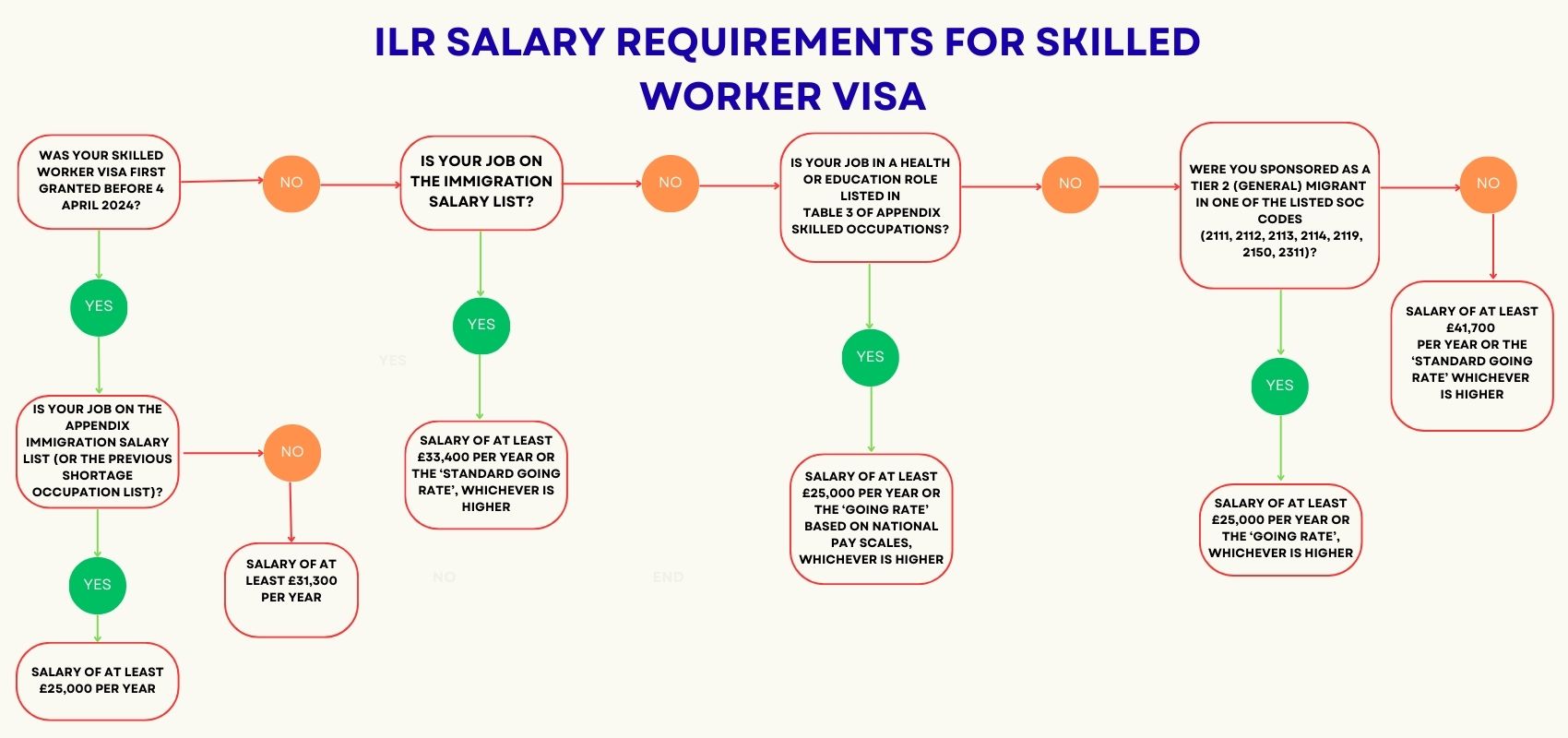
If you hold a Skilled Worker visa and are planning to apply for Indefinite Leave to Remain (ILR) in the UK you need to be aware of the latest salary requirements. The Home Office updated these rules on 4 April 2024 so your eligibility will depend on when your visa was granted and the job you are sponsored for.
1. General Eligibility for Skilled Worker Settlement
Before looking at salary rules applicants must meet these key requirements:
- Your current employer (sponsor) must still have a valid license to sponsor Skilled Workers.
- Your employer must still need you to work for them.
- You must be paid at or above the required salary for your job.
2. Salary Thresholds for Skilled Worker Settlement
The minimum salary you must earn depends on when your Skilled Worker visa was first granted and the job you are sponsored for.
A. Skilled Worker visas granted on or after 4 April 2024
- For standard jobs: £41,700 per year or the "going rate," whichever is higher.
- For jobs on the Immigration Salary List: £33,400 per year or the "going rate," whichever is higher.
B. Skilled Worker visas granted before 4 April 2024
If your Skilled Worker visa was granted before 4 April 2024, you may qualify under transitional salary thresholds:
- For standard jobs: £31,300 per year plus the relevant going rate.
- For jobs on the Immigration Salary List (or Shortage Occupation List): £25,000 per year plus the going rate.
- For health or education roles (SOC 2020, Table 3): £25,000 per year or the national pay scale rate, whichever is higher.
- For Tier 2 (General) migrants in specific SOC 2010 codes: £25,000 per year or the going rate listed in Home Office guidance.
3. Going Rate Requirement
In addition to meeting the general salary threshold, applicants for Skilled Worker settlement must also be paid at least the "going rate" for their specific occupation code (SOC code), as detailed in Appendix Skilled Occupations.
When can you apply for an ILR visa UK?
The length of time required for a Settlement Visa in the UK depends on the applicant's current immigration status.
| ILR Category | Current Immigration status or UK visa | Qualifying Indefinite Leave to Remain UK period |
|---|---|---|
| Work Route leading to ILR Visa UK | Tier 2 General visa or Skilled Worker Visa | After 5 years |
| Work Route leading to ILR Visa UK | Tier 2 (ICT) | After 5 years provided the initial grant is prior to 6 April 2010 |
| Work Route leading to ILR Visa UK | Tier 2 (Sportsperson) | After 5 years |
| Work Route leading to ILR Visa UK | Tier 2 (Minister of religion) | After 5 years |
| Family Route leading to ILR Visa UK | Spouse, unmarried partner or civil partner of a British Citizen or a person settled in the UK visa | After 5 years where the initial period of partner visa or spouse visa is granted after 9 July 2012 |
| EU Settlement Scheme | EU Settlement Scheme | After 5 years |
| Work Route leading to ILR Visa UK | Ancestry visa | After 5 years |
| Business Route leading to ILR Visa UK | Tier 1 (Entrepreneur) | After 3 or 5 years, depending on the business activity |
| Business Route leading to ILR Visa UK | Tier 1 (Investor) visa | After 2, 3 or 5 years, depending on the level of investment |
| Work Route leading to ILR Visa UK | Tier 1 (Exceptional Talent) visa | After 3 years |
| Work Route leading to ILR Visa UK | Tier 1 (Exceptional Promise) visa | After 5 years |
| Work Route leading to ILR Visa UK | Global Talent Visa | After 3 or 5 years, depending on the endorsement |
| Family Route leading to ILR Visa UK | PBS visa dependants or Dependant Visa | After 5 years |
| Long Residency | Long residence or 10 Years ILR | After 10 years of lawful residence in the UK |
| Business Route leading to ILR Visa UK | Innovator Visa | After 3 years |
| Business Route leading to ILR Visa UK | Sole Representative Visa | After 5 years |
Application Process
Step 1: Gather All Documents
Before you start the application process, make sure you have all the documents ready. Here is a list of what you will need:
- Current Passport and Previous Passports: Your valid passport and any previous passports used during your time in the UK. This will help to show your immigration history.
- Biometric Residence Permit (BRP): If you have one, include your expired BRP card.
- eVisa (Electronic Visa): If you entered the UK with an eVisa or have electronic immigration status, include printouts or screenshots of those records or your digital status.
- Proof of Continuous Residence: Documents proving your continuous residence in the UK during the qualifying period, such as utility bills, bank statements, tenancy agreements or council tax bills.
- English Language Evidence: Certificates or test results that meet the English language requirements of UK Visas and Immigration (UKVI).
- Life in the UK Test Certificate: Proof that you have passed the official Life in the UK Test.
- Employment or Self-Employment Evidence: Payslips, employer letters, contracts, or self-assessment tax returns demonstrating your work or business activities in the UK.
- Additional Supporting Documents: Any other relevant documents required by your visa category, such as marriage certificates or refugee status documents.
By having all these documents in order you will avoid delays and strengthen your Indefinite Leave to Remain (ILR) application.
Step 2: Complete the Online Application
Apply for your ILR online through the UK Visas and Immigration (UKVI) website. As you fill in the application form, remember:
- Enter your personal details correctly, including full name, date of birth and nationality.
- Be honest about your immigration history and include all visas and electronic immigration statuses you have held.
- Provide accurate information about your residency and any time spent outside the UK.
- Answer every question truthfully to avoid issues that could delay or even refuse your application.
Remember, honesty is key to a successful ILR application.
Step 3: Pay the ILR Application Fee
When applying for Indefinite Leave to Remain (ILR) the application fee can be high and varies depending on your visa category. Plan for the ILR application fee and remember to pay the biometric enrolment fee if applicable. All payments are made online when you submit your application. Keep your receipts and payment confirmations safe for future reference.
Step 4: Book and Attend a Biometric Appointment
Once you have submitted your application you will need to book your biometric appointment at a UKVCAS centre. Make sure you attend your appointment on time. If you miss it your application may be delayed or refused.
Step 5: Upload Documents
Upload all your documents using the UKVCAS online portal by the time of your biometric appointment. Make sure your documents are clear, legible and complete. Label your files as per UKVI instructions and keep your original documents handy as the Home Office may ask to verify them.
Step 6: Wait for the ILR Decision
ILR applications can take around six months to process. During this time the Home Office may ask for more information or even an interview. If you want to speed things up you may be able to use Priority Service or Super Priority Service, where available, for an additional fee.
Once your application is approved you will receive confirmation of your ILR status along with guidance on what it means to be a settled person in the UK.
Indefinite Leave to Remain (ILR) - Required Documents
Applying for Indefinite Leave to Remain (ILR) in the UK requires a thorough set of supporting documents. Missing or incorrect documents can cause delays or even refusal. Specific requirements may vary depending on your visa category and personal circumstances.
- Valid Passport(s): Include your current valid passport and any previous ones that show entry stamps, visa endorsements or travel history to and from the UK.
- Biometric Residence Permit (BRP): Include your latest BRP even if it has expired.
- eVisa (Electronic Immigration Status): If you have digital immigration status, include screenshots or printouts from your UKVI account showing your eVisa or immigration status.
- Proof of Continuous Residence in the UK: Provide utility bills, council tax statements, tenancy agreements, mortgage statements, bank statements, NHS letters or official correspondence covering the qualifying period.
- Employment and Financial Documentation: Employed applicants may need payslips, bank statements, contracts and employer letters. Self-employed applicants may need certified accounts, HMRC tax returns, invoices, client contracts and business bank statements.
- English Language Requirement: Provide an approved English language test certificate or a recognised degree certificate taught or researched in English, with a UK NARIC statement if needed.
- Life in the UK Test Certificate: Submit your official pass certificate unless exempt.
- Details of Travel Outside the UK: List dates of travel, reasons for each absence and total days spent outside the UK.
- Supporting Documents for Absences: Include employer letters, emergency travel evidence, boarding passes or travel confirmations where relevant.
- Marriage or Civil Partnership Certificate: Required if applying as a spouse or partner of a British citizen or settled person.
- Children's Birth Certificates: Provide full birth certificates showing both parents' names if children are dependants.
- Evidence of a Genuine and Subsisting Relationship: Family-based applications may need joint bills, bank statements, tenancy or mortgage evidence, photos, correspondence and proof of cohabitation.
- Accommodation: Provide evidence such as a tenancy agreement, mortgage statement, council tax bill or utility bill addressed to your UK residence.
- Previous Immigration Applications and Offences: Disclose previous UK visa applications, refusals, appeals and any civil, traffic or criminal offences.
How To Apply Online ILR Visa UK
This guide will help you through the online application process for Indefinite Leave to Remain (ILR) in the UK. Common application forms include:
- SET (M): For applicants applying as a spouse, civil partner, same-sex or unmarried partner of someone settled in the UK or a British citizen.
- SET (O): For applicants under routes such as Tier 2 General, Skilled Worker, Tier 1 Entrepreneur, Tier 1 Investor, PBS Dependant or Ancestry Visa.
- SET (LR): For applicants applying based on 10 years of lawful residence in the UK.
To start, fill out the relevant online forms available on the UKVI website and make sure your supporting documents are ready.
- Create an Online Account: Access the Gov.UK website, go to the ILR application section and register or log in.
- Fill in the Online Form: Provide personal details, current visa status, address history, employment history, criminal record information and absences from the UK.
- Pay the Application Fee: Check the current UKVI fee and pay online using a debit or credit card.
- Book a Biometric Appointment: Choose a date and time at a UKVCAS centre and attend the appointment with the required evidence.
- Upload Supporting Documents: Upload clear scans of the documents required for your route.
- Wait for a Decision: Track your application and respond quickly if the Home Office requests additional information.
ILR Visa UK Fees
Home Office fees for Indefinite Leave to Remain Application
| Applicant | Standard Application | Priority Service | Super Priority Service | Overseas Application |
|---|---|---|---|---|
| Main applicant | £3,226 | £3,726 | £4,226 | N/A |
| Partner or child aged under 18 (if applying together) | £3,226 | £3,726 | £4,226 | N/A |
| Partner or child aged under 18 (if applying later), or child aged over 18 | £3,226 | £3,726 | £4,226 | N/A |
ILR Visa UK Application Processing Time
Standard Processing Time
When applying for Indefinite Leave to Remain (ILR), the Home Office aims to process applications within 6 months. However, this can vary for different reasons.
Processing Time Factors
- Application Completeness: Make sure you submit all documents accurately. This will help avoid delays.
- ILR Route: There are various ILR routes, including work, family and long residency, and each has different processing times.
- Complex Case: If your case requires additional verification or has a complicated immigration history, this will take longer.
- Peak Periods: Processing times are longer during busy periods, holidays or specific times of the year.
- Biometric Information: Providing biometric information promptly is crucial. Attend your biometric appointment to keep things moving.
Being organised and aware of these factors helps.
Priority and Super Priority Services
When applying to the Home Office, you can use priority and super-priority services to speed up the process. Here is a quick summary:
- Priority Service: 5 working days.
- Super Priority Service: Next working day.
Tips to Expedite Your Application
To make your application process as smooth and quick as possible, here are some tips:
- Check Your Application: Double-check every section of the form.
- Submit All Documents: Use the UKVI checklist to ensure you include everything.
- Attend Biometric Appointments: Book your biometric appointment and go as soon as you can.
- Consider Priority Services: If time is of the essence, consider priority or super-priority services if eligible.
Follow these and you will avoid delays.
English Language Requirements for ILR Visa UK
When applying for Indefinite Leave to Remain (ILR) in the UK, you will need to meet the English Language Requirement. You may be able to meet this requirement if you:
- Pass an approved English language test at the required level, usually CEFR B1 or higher.
- Have a degree from a recognised institution where the course was taught or the research was conducted in English.
- Are a national from an English-speaking country.
What if I was absent from the UK?
When applying for Indefinite Leave to Remain (ILR) in the UK, it is important to know how time spent outside the UK will affect your application. The Home Office has a 180-day rule that restricts many applicants from being absent from the UK for more than 180 days in any 12-month period during the qualifying residency. Only full days normally count towards this limit.
The time from when you are granted entry clearance until you arrive in the UK can count towards your continuous residence. As long as your absences do not exceed the 180-day limit, you should usually be fine during that period. The visa route you are applying under can also make a difference. Some applicants may not need to explain absences under the limit, while sponsored work routes often require each absence to be justified.
It is a good idea to have an official letter from your employer for work-related or authorised absences. If you go over the allowed absence period without a valid reason or do not provide enough evidence, the Home Office may consider it a break in your continuous residence, which could lead to refusal.
In short, continuous residence is key to a successful ILR application. Track and document any travel outside the UK and stay within the limit throughout your qualifying residence.
What happens if your ILR Visa in the UK is successfully accepted?
After ILR
Once your ILR application is approved, your immigration status will be confirmed through a UKVI eVisa, not a Biometric Residence Permit (BRP). This digital format makes it easier to demonstrate your right to live, work and study in the UK permanently.
Once you receive your Indefinite Leave to Remain (ILR), you should:
- Log in to your UKVI account to check your eVisa and ensure all your details are correct.
- Share your immigration status digitally with your employer, landlord or other institutions as needed.
- Keep your ILR decision letter and related documents safe, especially for future applications such as British citizenship.
Having your Indefinite Leave to Remain eVisa means you have digital proof of your status, so there is no need to carry a physical card.
Maintaining ILR
Maintaining your ILR status is important to secure your residency in the UK. Try not to be away from the UK for too long. If you are outside the UK for over 2 years, you could lose your ILR status. You must also follow UK laws and regulations. Serious offences can put ILR status at risk.
What happens if my ILR UK Visa is refused?
If your ILR visa is refused, it can be a stressful and confusing experience. The Home Office will send a refusal letter explaining the specific grounds for refusal. Common issues include:
- Insufficient Residence Period: If you do not meet the qualifying residence period, your application may be refused.
- Excessive Absences from the UK: Being away from the UK for too long can affect continuous residence.
- Criminal Convictions: The Home Office carries out background checks and expects full disclosure.
- Financial Requirements: Some routes require evidence that you can financially support yourself and dependants.
- Incorrect or Incomplete Documentation: Missing or incorrect paperwork is a common reason for refusal.
- English Language Requirement: You must meet the relevant English language requirement unless exempt.
- Life in the UK Test: Most applicants must pass the Life in the UK Test unless exempt.
- Immigration Rule Violations: Overstaying or breaching visa conditions can affect your application.
- Changes in Circumstances: Changes such as job, marital status or address should be reported where required.
- Inconsistent Information: Discrepancies across immigration applications can put your application at risk.
Next Steps
If your ILR application is refused, what happens next depends on your current visa status. If you still have a valid visa, you can stay in the UK until that visa expires and may want to reapply for ILR once you have addressed the refusal reasons.
If your visa has expired or is about to expire, you should consider your options, such as leaving the UK, applying for an extension or applying for a different visa route to stay legally.
What to do next
- Read the Refusal Letter: Understand why the decision was made.
- Get Legal Advice: Speak to an immigration lawyer or adviser about your options.
- Appeal the Decision: Depending on the reason for refusal, you may have the chance to appeal or challenge the decision.
- Reapply for ILR: If the refusal reasons can be fixed, consider reapplying with corrected evidence.
- Alternative Visas: If ILR is not currently possible, consider other visa routes you may be eligible for.
Mitigating Future Refusal
To improve your chances of a successful ILR application in the future:
- Ensure Complete Documentation: Double check all required documents are included and up to date.
- Meet Eligibility Criteria: Check you meet the residence, financial and route-specific requirements.
- Correct Application: Fill out the visa application form accurately and honestly.
- Take Professional Advice: Consult an immigration adviser before submitting your application.
Returning Residents Visa UK
Life can be unpredictable and sometimes those with Indefinite Leave to Remain (ILR) may find themselves outside the UK for more than 2 years. Whether it is to care for aging parents, take up job opportunities abroad or deal with family matters, there are many valid reasons to be away. If you have been gone for more than 2 years your ILR has technically lapsed.
You may be eligible to return to the UK with a Returning Resident visa. This route is for those who once held settled status, had to leave for a while and now want to come back and make the UK their permanent home again.
The 2-Year Rule
When you get your Indefinite Leave to Remain in the UK it means you can live there permanently. However, if you stay outside the UK for more than 2 consecutive years you risk losing that status.
If you have been away for over 2 years and try to come back, you may be refused entry at the border. It is better to apply for a Returning Resident visa before you travel back rather than waiting until you arrive.
Who Can Apply as a Returning Resident?
The basic eligibility criteria are quite simple:
- You must genuinely intend to return to live in the UK permanently.
- You must have had settled status in the UK before you left, such as ILR or permanent residence.
- You should not have received public funds to help you leave the UK in the first place.
Even if you have been away longer than intended, you may still qualify if you have strong family ties in the UK or have spent most of your life here.
What You'll Need
When applying make sure you get all your documents in order. You may need:
- Proof of your previous ILR status, such as an old passport with the ILR stamp, an old BRP card or Home Office letters.
- Evidence of your time living in the UK before you left, such as utility bills, council tax statements or employment records.
- A clear explanation for your time away.
- Proof of ongoing ties to the UK, such as bank statements, property ownership or family relationships.
- Evidence of your genuine intention to live permanently in the UK.
How to Apply
- Apply online through the official UK government website.
- Pay the visa fee, currently £682 according to the supplied content.
- Provide biometric details, including fingerprints and a photo, at your nearest UK visa application centre.
- Upload all necessary supporting documents to show you qualify.
- Wait for a decision. Most applications are processed within 3 months, but complex cases may take longer.
Why This Route Is So Important
This route is important for those who had to leave the UK for good reasons but still see the UK as their home. Once you return with this visa, it can be as if your Indefinite Leave to Remain never lapsed. You get your privileges back including:
- The right to live, work and study anywhere in the UK.
- Access to public funds and NHS services.
- The ability to apply for British citizenship after 12 months if that is your goal.
The key point is that this visa is about your connection to the UK. If you can show strong ties and a genuine intention to return permanently, you may have a good chance of approval.
FAQs
-
Will ILR change from 5 years to 10 years?v
-
The UK government has proposed extending the standard ILR qualifying period to 10 years, with implementation expected from Autumn 2026. However, there is growing political debate about how these changes will be applied, particularly for migrants already in the UK.
-
-
What is earned settlement in the UK?v
-
Earned settlement means ILR may depend on income, skills and employment, English language ability and contribution to UK society. This represents a shift from a purely time-based system to a more merit-based approach.
-
-
Will the new ILR rules affect existing visa holders?v
-
This remains uncertain and under active political discussion. While ILR is usually assessed based on rules at the time of application, there are concerns about whether applying new rules to existing migrants would be retrospective and unfair. There is increasing pressure on the government to protect migrants already on a 5-year route and avoid sudden rule changes that disrupt long-term plans.
-
-
Should I apply for ILR before the new rules take effect?v
-
If you are close to qualifying, applying before Autumn 2026 may be the safest option. Even though retrospective changes are being debated, there is no guarantee that all applicants will be protected. Applying sooner can help you avoid uncertainty, secure ILR under current rules and reduce the risk of longer qualifying periods. The government’s earned settlement consultation has already closed, and final policy details are expected to determine how and when any changes will apply.
-
-
Is the ILR English language requirement changing?v
-
Yes. The English language requirement for many settlement applications is expected to increase from CEFR Level B1 to CEFR Level B2 from March 2027. Applicants applying on or after that date may need to meet the higher B2 requirement unless they are exempt.
-
-
Who can apply for ILR in the UK?v
-
You may be able to apply for ILR if you have completed the required qualifying period under an eligible immigration route, such as a Skilled Worker visa, Spouse visa, Partner visa, Ancestry visa, Global Talent visa, dependant visa, Innovator Founder route, or the 10 years lawful residence route.
-
-
Can I apply for ILR after 5 years?v
-
Many UK visa routes currently allow applicants to apply for ILR after 5 years, including Skilled Worker, Spouse or Partner, Ancestry, Global Talent and some dependant routes. You must also meet the residence, absence, English language, Life in the UK, salary and suitability requirements.
-
-
Can I apply for ILR after 10 years lawful residence?v
-
Yes. You may be able to apply for ILR under the 10 years lawful residence route if you have completed 10 continuous years of lawful residence in the UK and meet the relevant immigration rules.
-
-
What documents are required for Indefinite Leave to Remain?v
-
The documents required for ILR depend on your visa route, but commonly include your passport, eVisa or BRP evidence, proof of continuous residence, Life in the UK Test certificate, English language evidence, employment or salary documents, absence records, and any family or dependant evidence where relevant.
-
-
How many days can I stay outside the UK before applying for ILR?v
-
For many ILR routes, applicants must not have been outside the UK for more than 180 days in any 12-month period during the qualifying period. The exact absence rules can vary depending on your visa category, so you should check your travel history before applying.
-
-
Do I need to pass the Life in the UK Test for ILR?v
-
Most ILR applicants aged between 18 and 65 must pass the Life in the UK Test, unless they are exempt. The test checks your knowledge of British life, history, culture and society.
-
-
Can I apply for British citizenship after ILR?v
-
In many cases, you can apply for British citizenship after holding ILR for 12 months. If you are married to or in a civil partnership with a British citizen, you may be able to apply sooner, provided you meet the nationality requirements.
-
-
Can my spouse apply for Indefinite Leave to Remain in the UK?v
-
Yes. A spouse, civil partner or unmarried partner of a British citizen or settled person may be able to apply for ILR after completing the required qualifying period, usually 5 years, under the family visa route. They must also meet the relationship, residence, English language, Life in the UK and suitability requirements.
-
-
What is the difference between ILR and British citizenship?v
-
ILR allows you to live, work and study in the UK without time limits, but you remain a non-British citizen. British citizenship gives you full citizenship rights, including the ability to apply for a British passport, subject to meeting the naturalisation requirements.
-
-
Can I lose my ILR status?v
-
Yes. ILR can usually lapse if you stay outside the UK for more than 2 consecutive years. Serious criminal conduct, deception or other suitability issues may also put your ILR status at risk.
-
-
What is a Returning Resident visa?v
-
A Returning Resident visa is for someone who previously held ILR or settled status but has been outside the UK for more than 2 years and now wants to return to live in the UK permanently. Applicants must usually show strong ties to the UK and a genuine intention to return permanently.
-
-
What happens if my ILR application is refused?v
-
If your ILR application is refused, the Home Office will usually explain the reasons in a refusal letter. Depending on your circumstances, you may be able to reapply, appeal, request administrative review or apply for another visa route.
-
Family Route leading to ILR UK
Applicants who have spent 2 years (if applied prior to 9th July 2012) or 5 years (if applied on or after 9th July 2012) in the UK on a spouse visa, unmarried partner or civil partner visa of a British National or Settled person or as a PBS dependant

Long Residency
Applicants must have at least 10 years lawful residence in the UK to apply for Indefinite Leave to Remain UK (ILR Visa UK). They need to show a strong connection with the UK.
Work Category leading to ILR UK
This category is designed for applicants who have spent continuous residence of 5 years in the work categories including Tier 1 (General), Tier 2 (General), Ancestry visa, etc and wish to apply for Indefinite Leave to Remain UK
EEA Permanent Residence
This category allows an EEA national who has spent at least 5 years as a qualified person in the UK.
